FFacts On Tap Editorial Team Fact-checkedUpdated November 13, 20253 min read
Share
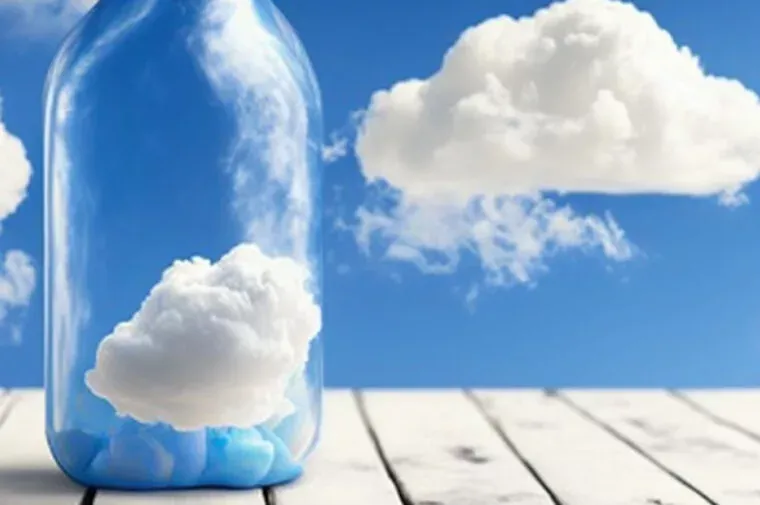
Real clouds form when warm, moist air rises, cools, and its water vapor condenses onto tiny particles of dust, smoke, or pollen floating in the sky. You don't need to wait for cloudy weather to see this happen, though. With a plastic bottle, warm water, and a lit match, you can trigger the same condensation process in your hands.
This simple experiment is a favorite in classrooms because it makes an invisible process, condensation driven by air pressure, visible in seconds.
Clouds are made of countless tiny water droplets or ice crystals suspended in the air.
Clouds form when warm, moist air rises and cools, causing water vapor to condense onto microscopic particles of dust, smoke, sea salt, or pollen.
These microscopic particles are called condensation nuclei; without them, water vapor tends to stay invisible as a gas even in humid air.
A cloud's shape and appearance are influenced by temperature, humidity, wind speed, and altitude.
To make a cloud in a bottle, fill a clear plastic bottle about one-third full with warm water and swirl it to moisten the inside walls.
Dropping a lit match into the bottle and quickly capping it fills the bottle with smoke particles that act as condensation nuclei.
Squeezing the bottle compresses the air inside, raising its pressure and temperature slightly, which encourages more water to evaporate.
Releasing the squeeze lets the air expand, dropping its pressure and temperature quickly, which causes water vapor to condense onto the smoke particles.
The resulting droplets are what make the cloud visible, scattering light the same way real fog or mist does.
Squeezing the bottle again reverses the process, causing the tiny cloud to disappear as the droplets evaporate back into vapor.
Warm water works better than cold water because warmer water evaporates faster, putting more water vapor into the air inside the bottle.
Holding the bottle against a dark background makes the faint cloud much easier to see.
This experiment demonstrates the same basic physics used in real cloud chambers, which scientists have used since the early 1900s to visualize particle tracks using rapid pressure changes.
Some versions of this experiment substitute a small amount of rubbing alcohol for water, since it evaporates even more readily, though it should be used in a well-ventilated area away from open flame.
Any clear, sealable container, such as a glass jar, can be used instead of a plastic bottle.
Frequently asked questions
Why do I need smoke particles to make a cloud?
Water vapor needs a solid surface to condense on, such as dust, smoke, or pollen particles known as condensation nuclei. Without them, the water vapor mostly stays invisible in the air.
Why does warm water work better than cold water?
Warm water evaporates faster than cold water, so it puts more water vapor into the air inside the bottle. More water vapor means more material available to condense into a visible cloud when the pressure drops.
Can I use other liquids besides water?
Yes, liquids that evaporate easily, such as rubbing alcohol, can work well. Use them only in a well-ventilated space, away from the match flame, since some are flammable and their fumes shouldn't be inhaled.
Can I use other containers besides a plastic bottle?
Yes, any clear container with an airtight, sealable opening works, such as a glass jar or a metal can with a lid.
Is this the same principle used in real weather clouds?
Yes. Real clouds form the same way, as rising air cools and expands, its water vapor condenses onto microscopic particles in the atmosphere, just on a much larger scale.
We write every article to be genuinely fun — and genuinely true. Each fact is checked against reputable sources before it goes live. Spotted something off? Tell us and read our fact-check policy.