FFacts On Tap Editorial Team Fact-checkedUpdated July 20, 20263 min read
Share
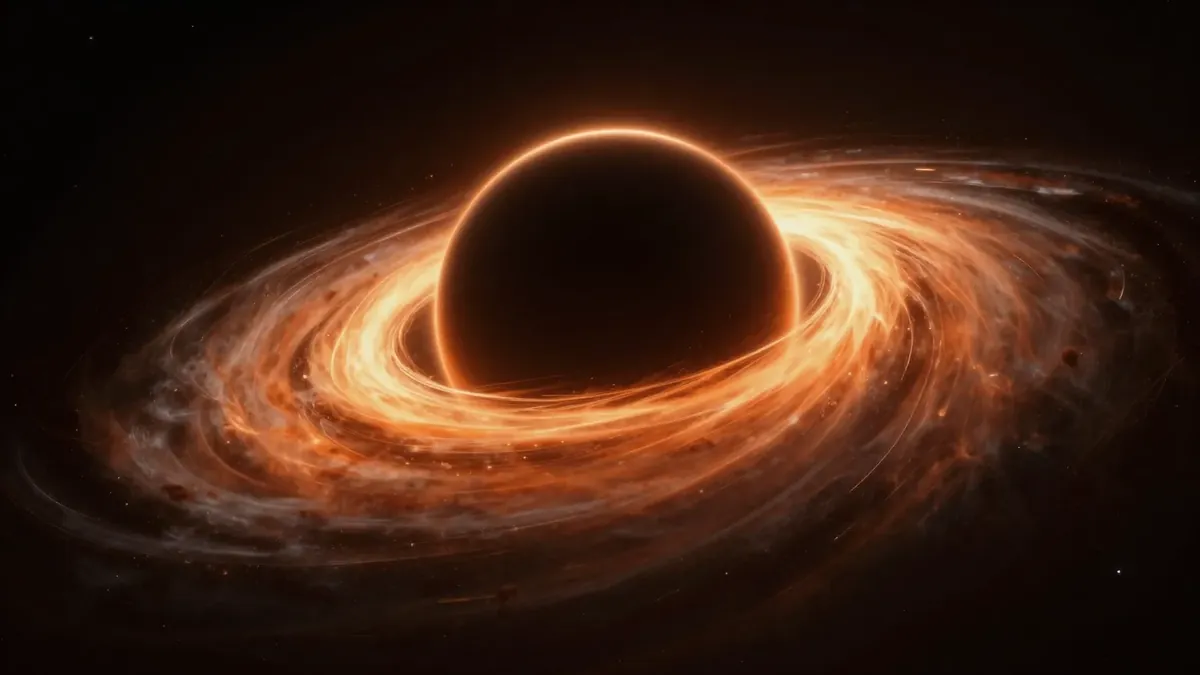
A black hole is a region of space where gravity is so strong that nothing — not even light — can escape once it crosses the boundary called the event horizon. They sound like science fiction, yet astronomers have now photographed them, heard them collide, and found one sitting at the heart of our own galaxy.
Here are the facts, checked against NASA, the Event Horizon Telescope, and LIGO.
A black hole is a region where gravity is so intense that nothing, not even light, can escape after crossing its event horizon.
Black holes were predicted by Einstein's general theory of relativity in 1915, decades before any were observed.
The name 'black hole' was popularized by physicist John Archibald Wheeler in 1967.
The first-ever image of a black hole — the supermassive black hole in galaxy M87 — was released by the Event Horizon Telescope collaboration in April 2019.
Our own galaxy hosts a supermassive black hole called Sagittarius A*, about 4 million times the mass of the Sun, roughly 26,000 light-years from Earth; its image was released in 2022.
Stellar-mass black holes form when very massive stars run out of fuel and collapse at the end of their lives.
Supermassive black holes can contain millions to billions of times the mass of the Sun, and the most extreme, like TON 618, are estimated at tens of billions of solar masses.
Cygnus X-1, discovered as an X-ray source in 1964, became the first widely accepted black hole candidate in our galaxy.
In 2015, the LIGO observatories made the first direct detection of gravitational waves — ripples in spacetime from two black holes merging over a billion light-years away.
Time runs measurably slower in strong gravity, so a clock near a black hole would tick more slowly than one far away — a confirmed prediction of relativity.
Stephen Hawking showed in 1974 that black holes should emit faint 'Hawking radiation' and could eventually evaporate over unimaginably long timescales.
Black holes are not cosmic vacuum cleaners: if the Sun were replaced by a black hole of equal mass, the planets would keep orbiting exactly as they do now.
A black hole with the mass of the Sun would have an event horizon only about 6 kilometers (4 miles) across.
An object falling into a small black hole would be stretched into a long strand by tidal forces — a process physicists genuinely call 'spaghettification'.
The 2020 Nobel Prize in Physics went to Roger Penrose, Reinhard Genzel, and Andrea Ghez for showing black holes are real consequences of relativity and for revealing the one at our galaxy's center.
Frequently asked questions
Could a black hole swallow Earth?
No known black hole is close enough to threaten Earth. Black holes don't wander around 'sucking in' matter — objects have to fall almost directly toward one to be captured.
What would happen if you fell into a black hole?
Near a stellar-mass black hole, tidal forces would stretch you apart ('spaghettification'). For a supermassive black hole, you could cross the event horizon without noticing anything special at that moment — but you could never return.
Do black holes last forever?
Probably not. Hawking radiation suggests black holes slowly lose mass and could evaporate, but for a stellar-mass black hole this would take vastly longer than the current age of the universe.
How do scientists see something that emits no light?
They observe its effects: stars orbiting an invisible mass, superheated gas glowing around it, X-ray emission, and gravitational waves from collisions. The Event Horizon Telescope images the glowing 'shadow' around the event horizon.
What's the difference between a stellar and a supermassive black hole?
Stellar-mass black holes (roughly 5–100 solar masses) form from collapsing stars. Supermassive black holes (millions to billions of solar masses) sit at the centers of most large galaxies, and exactly how they grew so large is still an active research question.
We write every article to be genuinely fun — and genuinely true. Each fact is checked against reputable sources before it goes live. Spotted something off? Tell us and read our fact-check policy.