FFacts On Tap Editorial Team Fact-checkedUpdated July 20, 20263 min read
Share
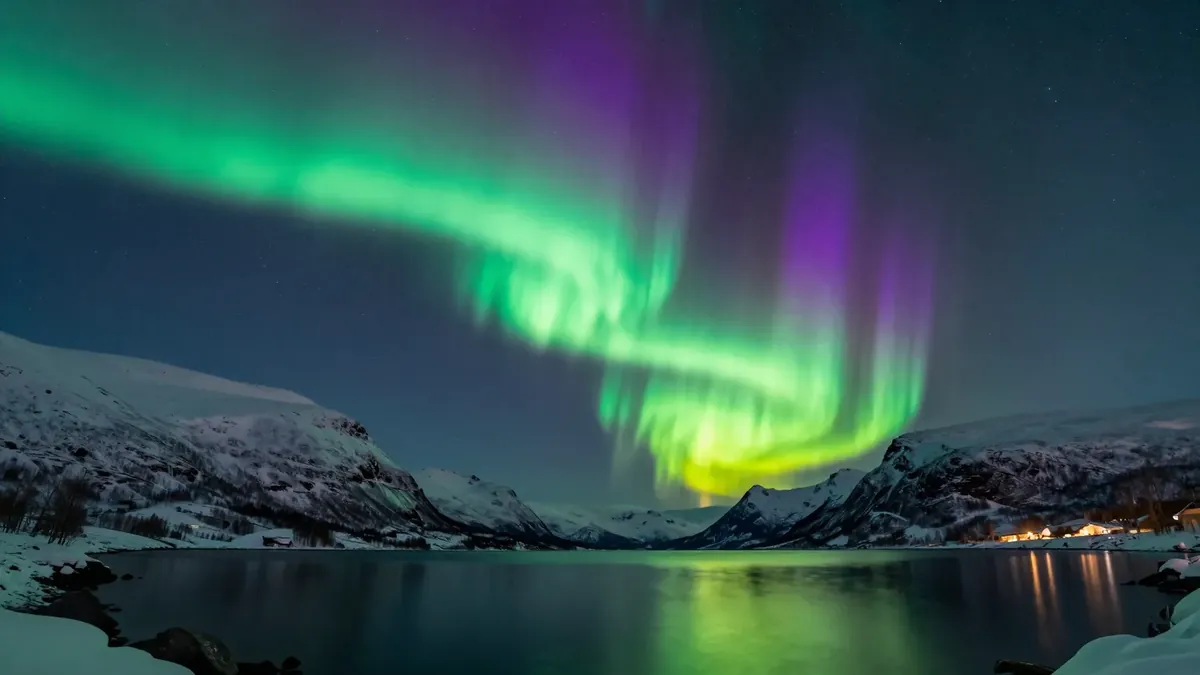
Few sights on Earth stop people in their tracks like the aurora borealis — shimmering curtains of green, purple, and red light rippling across a dark polar sky. The science behind them is even better than the folklore.
Here's what's really going on up there, verified against NOAA and NASA.
Auroras happen when charged particles from the Sun are funneled by Earth's magnetic field toward the poles, where they collide with gases in the upper atmosphere and make them glow.
The aurora's colors come from different gases and altitudes: oxygen produces the common green (and rarer high-altitude red), while nitrogen contributes blues, purples, and pinks.
The southern hemisphere has its own version — the aurora australis — which mirrors the northern lights around the south pole.
Auroras typically occur between about 100 and 640 kilometers (60–400 miles) above the ground — far above where airplanes fly.
The best viewing sits under the 'auroral oval': northern Norway, Sweden, Finland, Iceland, Greenland, northern Canada, and Alaska.
The name 'aurora borealis' — from Aurora, Roman goddess of dawn, and Boreas, Greek god of the north wind — is commonly credited to Galileo in 1619.
Auroral activity follows the Sun's roughly 11-year cycle; around solar maximum, displays become more frequent and reach farther from the poles.
In May 2024, the strongest geomagnetic storm since 2003 pushed auroras to extraordinarily low latitudes, with sightings reported across much of the United States and Europe.
Space weather agencies rate geomagnetic storms with the Kp index (0–9); the higher the number, the farther from the poles the aurora can be seen.
Auroras aren't unique to Earth — spacecraft have photographed them on Jupiter and Saturn, whose magnetic fields also channel charged particles.
Strong geomagnetic storms can disrupt satellites, radio communications, and power grids — the 1859 'Carrington Event' set telegraph equipment sparking.
Some studies, notably from Finland, suggest auroras may occasionally produce faint crackling sounds under rare conditions.
Cultures across the Arctic wove the lights into legend — from spirits playing games in Inuit traditions to omens recorded in Norse and medieval European chronicles.
Frequently asked questions
When is the best time to see the northern lights?
Roughly September through March in the far north, on dark, clear nights away from city lights — often between about 10 pm and 2 am local time.
Can you see the aurora with the naked eye?
Yes. Bright displays are unmistakable, though cameras pick up more color than the eye, so faint auroras can look gray-green in person but vivid in photos.
Do the northern lights happen every night?
Auroral activity is always occurring at some level around the poles, but visible displays depend on solar activity, darkness, and clear skies.
Are the northern lights dangerous?
Not to people on the ground — they occur far too high. However, the geomagnetic storms that cause them can affect satellites, radio signals, and power grids.
Why were auroras visible so far south recently?
The Sun has been near the peak of its activity cycle, and severe storms — like the May 2024 event — push the auroral oval much farther from the poles than usual.
We write every article to be genuinely fun — and genuinely true. Each fact is checked against reputable sources before it goes live. Spotted something off? Tell us and read our fact-check policy.