FFacts On Tap Editorial Team Fact-checkedUpdated March 18, 20263 min read
Share
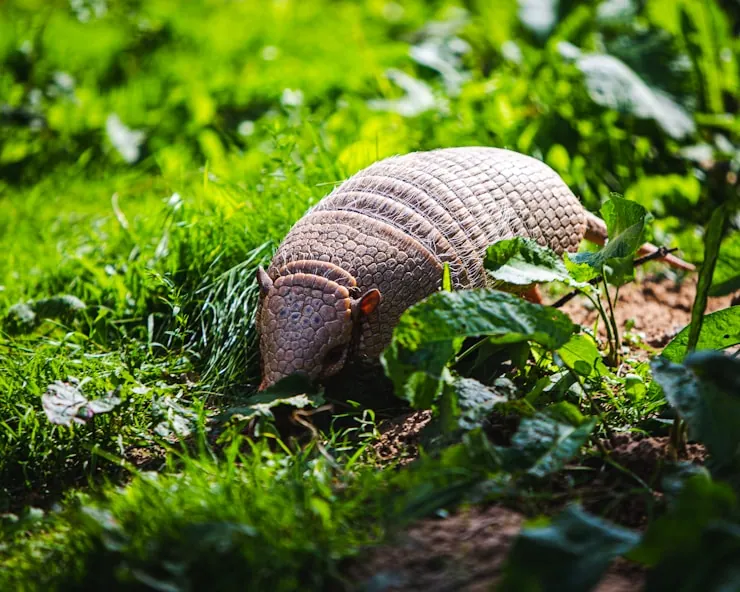
Armadillos are small armored mammals best known for their bony, plated shells and nocturnal digging habits. Native to the Americas, they range from the tiny pink fairy armadillo to the giant armadillo, which can weigh over 100 pounds.
Below are verified facts about these odd, endearing creatures, from their surprising swimming ability to their unusual reproductive quirks.
Armadillos get their name from the Spanish word "armado," meaning "armored," a reference to the bony plates covered in tough, leathery skin that make up their shell.
Armadillos are surprisingly good swimmers. They can hold their breath for several minutes and cross narrow streams by walking along the bottom, or swim across wider water by gulping air into their stomach and intestines to increase buoyancy.
Armadillos are mostly nocturnal, relying on a strong sense of smell to find insects, grubs, and other small prey in the dark since their eyesight is poor.
Female nine-banded armadillos almost always give birth to four genetically identical offspring from a single fertilized egg, a rare reproductive trait called polyembryony.
Armadillos are powerful diggers, using their strong claws to excavate burrows for shelter and to unearth the insects, larvae, and worms that make up most of their diet.
Nine-banded armadillos can live roughly 7 to 20 years in the wild depending on the source, with some individuals in captivity living even longer.
Despite their armored, lumbering look, armadillos can sprint at speeds of up to about 30 miles per hour in short bursts when startled.
The nine-banded armadillo is the only armadillo species native to the United States, and it typically escapes danger by bolting or digging rather than curling into a ball.
Only a few armadillo species, such as the three-banded armadillo, can roll into a tight, fully enclosed ball for defense; the nine-banded armadillo's shell cannot close completely.
Armadillos have small eyes covered by a thin membrane and rely far more on smell and hearing than sight to navigate their surroundings.
Armadillos belong to a group of mammals called xenarthrans, which also includes anteaters and sloths, and their fossil relatives date back tens of millions of years in the Americas.
There are about 20 living species of armadillo, found mostly in Central and South America, with only the nine-banded armadillo ranging widely into the United States.
Armadillos can carry the bacterium that causes leprosy (Hansen's disease) and are one of the few known non-human animal reservoirs for it, so direct contact with wild armadillos is discouraged.
Frequently asked questions
Are armadillos dangerous to humans?
Armadillos are not aggressive toward humans, but they can carry the bacterium that causes leprosy and, less commonly, the parasite behind Chagas disease. It's best to avoid handling wild armadillos or their droppings.
Do armadillos make good pets?
No. Armadillos are wild animals with specialized diets, strong digging instincts, and nocturnal habits that make them unsuitable and often illegal to keep as pets in many areas.
How many species of armadillos are there?
There are roughly 20 living armadillo species, though only the nine-banded armadillo is found in the United States.
Can armadillos roll into a ball like a pill bug?
Only a few species, most notably the three-banded armadillo, can roll into a nearly complete, tight ball. The common nine-banded armadillo's shell doesn't close all the way, so it usually flees or digs to escape danger instead.
What is the biggest threat to armadillos in the wild?
Habitat loss from deforestation and urban development, along with road mortality, are among the biggest threats to armadillo populations.
How fast can armadillos run?
Armadillos can sprint at speeds up to about 30 miles per hour in short bursts, using speed and quick burrowing to escape predators.
We write every article to be genuinely fun — and genuinely true. Each fact is checked against reputable sources before it goes live. Spotted something off? Tell us and read our fact-check policy.