FFacts On Tap Editorial Team Fact-checkedUpdated August 16, 20233 min read
Share
Fruit bats, also called megabats or flying foxes, are among the largest bats on Earth and a keystone species for tropical forests. Unlike their smaller echolocating cousins, most fruit bats find their way in the dark using sharp eyesight and an excellent sense of smell.
Here are some fun, verified facts about these gentle, oversized winged mammals.
Fruit bats, or flying foxes, are the largest bats in the world; some species, like the giant golden-crowned flying fox, have a wingspan approaching 5.5 feet.
They are called "megabats" because they belong to the family Pteropodidae, which includes the largest bat species, distinguishing them from the smaller "microbats."
Fruit bats rely on excellent eyesight and a keen sense of smell, not echolocation, to find their favorite fruits and flowers at night.
Many fruit bat species have a long tongue adapted for lapping up nectar deep inside flowers.
Fruit bats have flat molar teeth suited for crushing and mashing soft fruit, rather than the sharp, tearing teeth of a predator.
Fruit bats are important pollinators for hundreds of plant species, including durian, mango, banana, and agave.
A single fruit bat can eat close to its own body weight in fruit and nectar in one night of foraging.
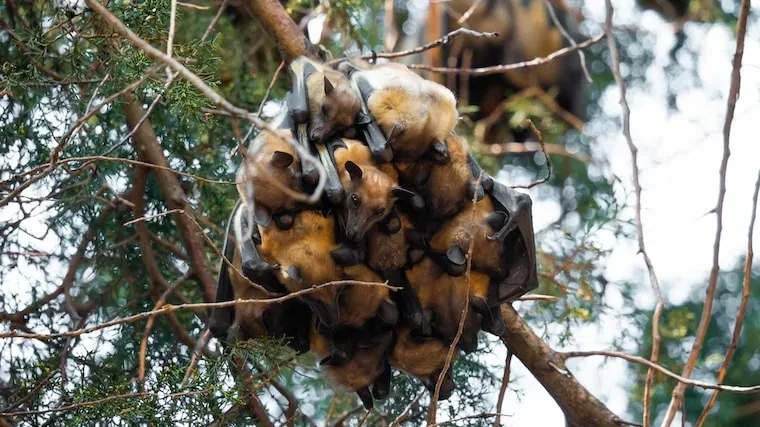
Fruit bats are nocturnal, resting during the day and flying out at dusk to forage.
Fruit bats are highly social and often roost together in colonies that can number in the thousands.
During the day, fruit bats roost in trees, hanging upside down in large, noisy groups.
Fruit bats live in tropical and subtropical regions across Africa, Asia, Australia, and the Pacific Islands.
Unlike most microbats, the vast majority of fruit bat species do not use echolocation at all; only bats in the genus Rousettus use a simple form of tongue-click echolocation.
Fruit bats are not blind - in fact, they have unusually good night vision compared to most mammals.
Fruit bats are not dangerous to humans and will not attack people; most bites occur only if one is handled or cornered.
Despite the nickname "flying fox," fruit bats are not vampires and do not drink blood - only three vampire bat species (unrelated microbats found in Latin America) do that.
By spreading seeds and pollinating night-blooming flowers, fruit bats help regenerate tropical forests after clearing or fire damage.
Many fruit bat species are threatened by habitat loss, hunting for bushmeat, and culling linked to disease fears.
Dozens of fruit bat species are now listed as vulnerable or endangered by the IUCN, including several island flying foxes.
In the wild, flying foxes typically live around 15 years, though some individuals in protected colonies or captivity have lived over 20 years.
Fruit bat colonies communicate through a wide range of vocalizations and body postures, including squabbling calls over roosting spots.
In many Pacific Island and Southeast Asian cultures, flying foxes hold symbolic importance and appear in local folklore and traditions.
Frequently asked questions
What do fruit bats eat?
Fruit bats primarily eat fruit, nectar, and pollen from flowering plants. Some species also eat leaves or a small amount of insects.
Are fruit bats dangerous?
Fruit bats are not aggressive and do not attack people. However, like other wild animals, they can carry pathogens such as the Nipah virus, so they should never be handled directly.
Where do fruit bats live?
Fruit bats live throughout the tropical and subtropical regions of Africa, Asia, Australia, and the Pacific Islands, typically roosting in large tree colonies.
Do fruit bats use echolocation?
Most fruit bats do not use echolocation. They rely instead on strong eyesight and smell. The genus Rousettus is a notable exception, using simple tongue-click echolocation to navigate dark roosting caves.
What is the role of fruit bats in the ecosystem?
Fruit bats pollinate night-blooming flowers and disperse seeds over long distances, which helps tropical forests regenerate and stay genetically diverse.
Why are some fruit bat species endangered?
Many fruit bat populations are declining due to deforestation, hunting for food, and culling campaigns driven by fear of disease transmission.
We write every article to be genuinely fun — and genuinely true. Each fact is checked against reputable sources before it goes live. Spotted something off? Tell us and read our fact-check policy.