FFacts On Tap Editorial Team Fact-checkedUpdated May 2, 20253 min read
Share
The Gaboon viper (Bitis gabonica) is one of Africa's most striking snakes, found in the rainforests and savannas of sub-Saharan Africa. Famous for its intricate camouflage pattern, massive size, and record-breaking fangs, it's a favorite among snake enthusiasts and researchers alike.
Despite its fearsome reputation, the Gaboon viper is a slow, patient ambush predator that would rather hide than fight. Here are the real facts behind this remarkable reptile.
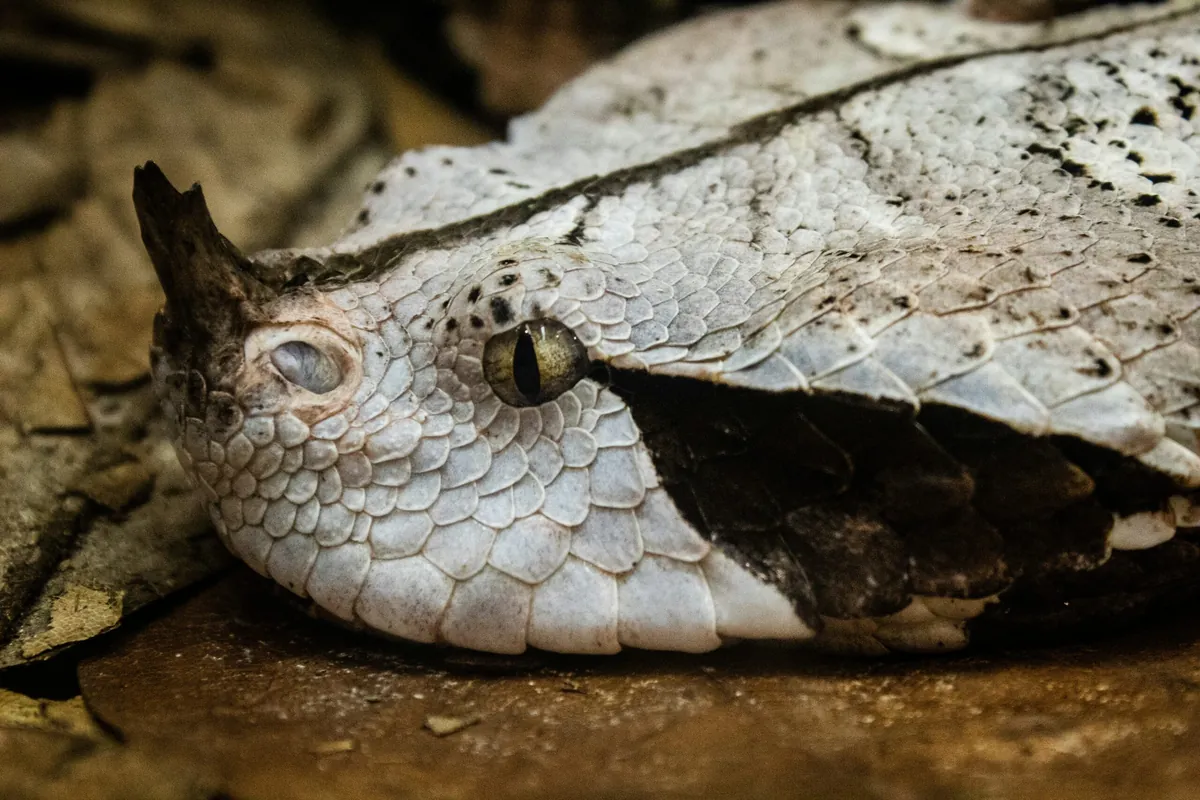
Gaboon vipers have a triangular head and a broad, heavy body covered in an intricate mosaic of brown, purple, yellow, and black scales that serves as near-perfect camouflage on the forest floor.
Gaboon vipers have the longest fangs of any snake species, reaching up to 2 inches (about 5 cm) long, which they use to deliver venom deep into prey.
Their venom is a potent mix of cytotoxins and other compounds that can cause severe pain, swelling, and tissue damage in humans, making prompt medical treatment essential after a bite.
Despite their bulk, Gaboon vipers are masters of camouflage, disappearing into leaf litter so effectively that they are easy to step on by accident.
They are ambush hunters rather than active foragers, lying motionless for hours or even days while waiting for prey like rodents and birds to wander close.
Gaboon vipers give birth to live young rather than laying eggs, with litters commonly ranging from about 20 to 40 babies, though larger females can produce even more.
The species is classified as Vulnerable on the IUCN Red List, with habitat loss and deforestation across its range considered the main threats.
In captivity, Gaboon vipers can live around 18 to 20 years with proper care, which is long for a snake of its size.
When alarmed, Gaboon vipers can produce one of the loudest hisses of any snake, a warning sound audible for a considerable distance.
Some researchers have observed Gaboon vipers using a slow tail movement, known as caudal luring, to attract curious prey within striking range.
Many taxonomists now split the historical 'Gaboon viper' into two species: Bitis gabonica in Central and East Africa, and the West African Gaboon viper, Bitis rhinoceros, which has small horn-like scales on its nose.
Gaboon vipers are generally shy and reluctant to bite, relying first on camouflage and stillness to avoid confrontation with humans and predators.
Frequently asked questions
What do Gaboon vipers eat?
Gaboon vipers primarily feed on small mammals and birds, using their camouflage to ambush prey rather than actively chasing it.
How dangerous is a Gaboon viper's bite to humans?
A bite can be medically serious, causing severe pain, swelling, and tissue damage, so immediate medical attention with antivenom is important. Fatalities are uncommon when treated promptly, but the bite should always be treated as an emergency.
Are Gaboon vipers aggressive toward humans?
No, they are typically calm and reluctant to strike, preferring to rely on camouflage and stillness. They usually only bite when stepped on, handled, or cornered.
Where can Gaboon vipers be found in the wild?
They live in the rainforests and savannas of sub-Saharan Africa, including countries such as Nigeria, Cameroon, Gabon, and the Democratic Republic of the Congo.
How can people help conserve Gaboon vipers?
Supporting habitat protection, reducing deforestation, and backing conservation and research organizations working in their native range all help protect the species, which is listed as Vulnerable.
Can Gaboon vipers be kept as pets?
Some experienced keepers do keep them, but they require specialized venomous-snake handling experience, secure enclosures, and often permits, so they are not suitable as casual pets.
We write every article to be genuinely fun — and genuinely true. Each fact is checked against reputable sources before it goes live. Spotted something off? Tell us and read our fact-check policy.