FFacts On Tap Editorial Team Fact-checkedUpdated May 5, 20264 min read
Share
Galápagos tortoises are the largest living tortoises on Earth, and among the longest-lived vertebrates on the planet. Native to the Galápagos Islands off Ecuador, these giant reptiles helped inspire Charles Darwin's theory of evolution and remain a powerful symbol of conservation today.
Here are the real facts behind these remarkable animals, from their record-setting size to the threats they've survived.
Galápagos tortoises are believed to have descended from mainland South American ancestors that reached the islands millions of years ago, likely by drifting on vegetation or natural rafts across the ocean.
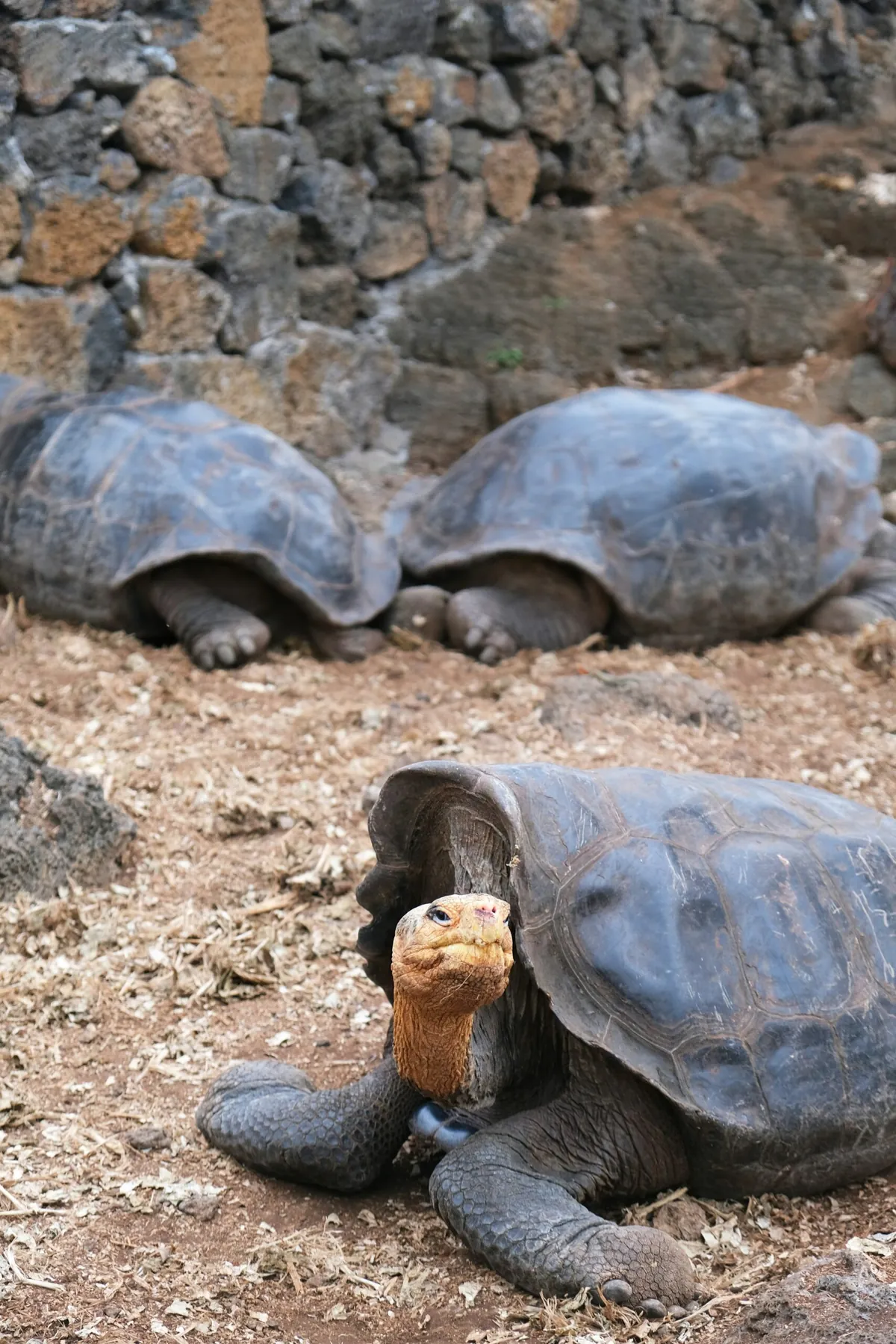
They are the largest living species of tortoise, with big males reaching over 5 feet in length and weighing up to 500 pounds.
Their large size is thought to be an adaptation that helps them store more water and travel farther in search of the islands' sparse, patchy food and water sources.
Galápagos tortoises are among the longest-lived vertebrates, with wild individuals commonly living well over 100 years.
The world's oldest known living land animal is a tortoise named Jonathan, who is estimated to be around 193 years old as of 2026 — but Jonathan is actually a Seychelles giant tortoise living on the island of Saint Helena, not a Galápagos tortoise.
A tortoise's shell shape often reveals which island it comes from: dome-shaped shells are typical on islands with abundant, low-growing vegetation, while saddleback shells, with a raised front opening, are found on drier islands where tortoises must stretch upward to reach taller plants.
Galápagos tortoises are herbivores, grazing mainly on grasses, leaves, cactus pads, and fruit.
They have a very slow metabolism and can survive for up to a year without eating or drinking, an adaptation that once made them a prized (and grim) source of fresh meat for sailors and whalers, who stacked them live in ship holds.
Galápagos tortoises faced severe population declines from historical overhunting by sailors, plus ongoing threats from introduced species like rats, pigs, and goats that destroy nests and habitat.
Males compete for mates through head-bobbing displays and can be aggressive toward rivals; females dig shallow nests in sandy or dry ground and lay clutches of roughly 2 to 16 eggs, which incubate for about 4 to 8 months.
The Galápagos Islands are a UNESCO World Heritage Site, a designation they received in 1978.
The Galápagos National Park, which protects the islands' ecosystems including the tortoises, was established in 1959.
Lonesome George was the last known individual of the Pinta Island tortoise subspecies. Discovered in 1971, he died on June 24, 2012, and his subspecies is now considered extinct.
Differences in shell shape and size among tortoises on different Galápagos islands were among the observations that helped shape Charles Darwin's thinking on evolution by natural selection during his 1835 visit.
Conservation programs, including captive breeding and headstarting young tortoises before releasing them, have helped several Galápagos tortoise populations recover from the brink of extinction.
Frequently asked questions
Why are Galápagos tortoises significant to science?
Their island-by-island variations in shell shape and size were among the observations that helped Charles Darwin develop his theory of evolution by natural selection.
How big do Galápagos tortoises get?
They are the largest living tortoise species, with big individuals reaching over 5 feet long and up to 500 pounds.
How long do Galápagos tortoises live?
They regularly live over 100 years in the wild. Some captive individuals have lived even longer, though the record-holding oldest tortoise alive today, Jonathan, is actually a Seychelles giant tortoise, not a Galápagos species.
What are the main threats to Galápagos tortoises?
Historically, overhunting by sailors devastated populations. Today the main threats are introduced species such as rats, pigs, and goats, which prey on eggs and young or destroy habitat, along with historical habitat loss.
What is the current conservation status of Galápagos tortoises?
Most surviving subspecies are listed as vulnerable, endangered, or critically endangered by the IUCN. Captive breeding and habitat restoration programs run by the Galápagos National Park and Galápagos Conservancy have helped several populations rebound.
Who was Lonesome George?
Lonesome George was the last known Pinta Island tortoise, found in 1971. Despite conservation efforts to find him a mate, he died in 2012 without producing offspring, and his subspecies is now considered extinct.
We write every article to be genuinely fun — and genuinely true. Each fact is checked against reputable sources before it goes live. Spotted something off? Tell us and read our fact-check policy.