FFacts On Tap Editorial Team Fact-checkedUpdated July 20, 20263 min read
Share
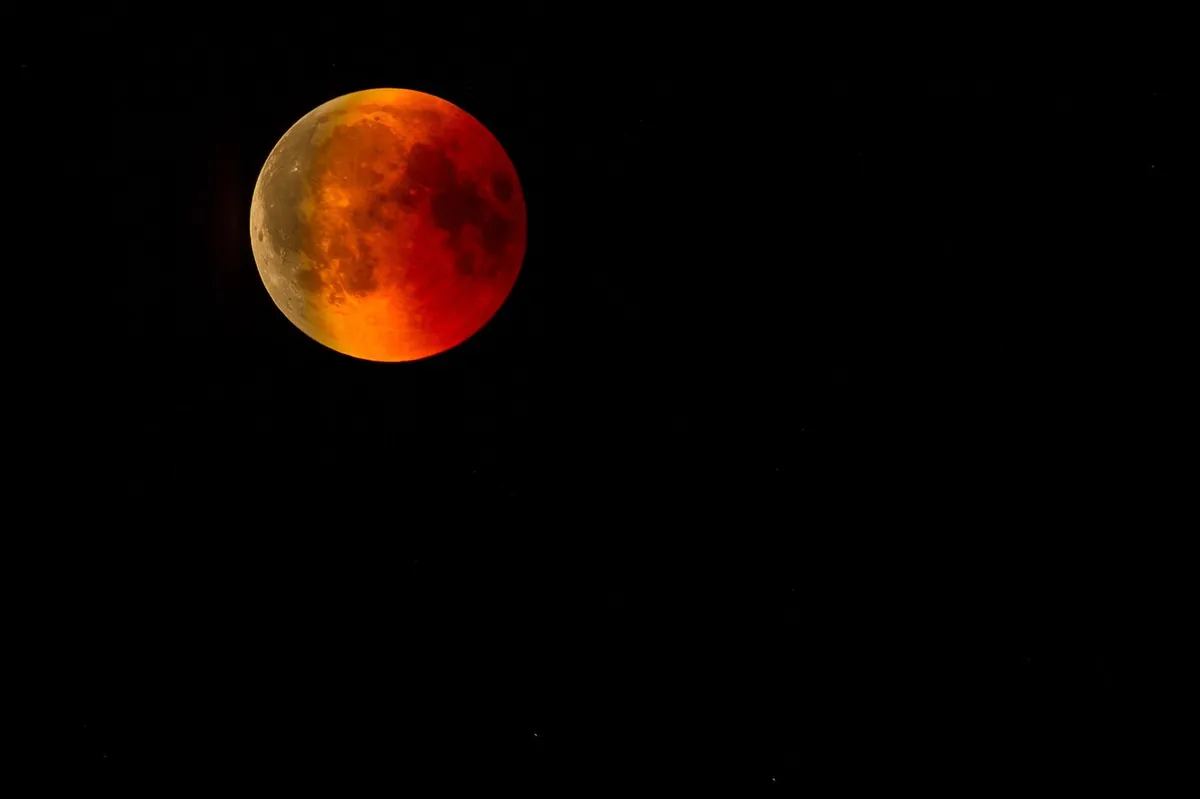
During a lunar eclipse, the Moon drifts into Earth's shadow and can glow an eerie coppery red — the famous 'blood moon.' Unlike a solar eclipse, it's completely safe to watch with your own eyes.
Here are the fact-checked essentials, including the deep partial eclipse coming on August 28, 2026.
A lunar eclipse happens when the Earth passes directly between the Sun and the Moon, casting its shadow on the Moon.
Lunar eclipses only occur at a full moon, and only when the Sun, Earth, and Moon line up closely enough.
There are three types: total (the Moon fully enters Earth's dark umbra), partial, and penumbral (the Moon passes through Earth's faint outer shadow).
On August 28, 2026, a deep partial lunar eclipse will see about 96% of the Moon slip into Earth's umbra, visible across most of the Americas, Europe, and Africa.
During a total lunar eclipse the Moon often turns red — the 'blood moon' — because sunlight bent through Earth's atmosphere is stripped of blue light, leaving red to fall on the Moon.
In effect, the red glow of a blood moon is the light of all the world's sunrises and sunsets projected onto the Moon at once.
Unlike a solar eclipse, a lunar eclipse is completely safe to watch with the naked eye, binoculars, or a telescope.
A total lunar eclipse can last much longer than a solar one — totality can stretch well over an hour.
Lunar eclipses are visible from anywhere on the night side of Earth, so far more people can see them than a given solar eclipse.
There are usually two to four lunar eclipses each year, though not all are total.
The exact shade of a blood moon varies from bright orange to deep brick-red depending on dust, clouds, and volcanic ash in Earth's atmosphere.
Christopher Columbus reportedly used his foreknowledge of a 1504 lunar eclipse to frighten Indigenous people into giving his stranded crew supplies.
Ancient Greek thinkers used the curved shadow Earth casts on the Moon during eclipses as evidence that the Earth is round.
A 'Blood Moon' that coincides with a supermoon (the Moon near its closest point to Earth) makes the eclipsed Moon appear especially large and vivid.
Because the geometry repeats, eclipses recur in an 18-year, 11-day cycle known as the saros.
Frequently asked questions
When is the next lunar eclipse?
A deep partial lunar eclipse occurs on August 28, 2026, with about 96% of the Moon entering Earth's shadow. It will be visible across most of the Americas, Europe, and Africa.
Why does the Moon turn red during an eclipse?
Earth's atmosphere bends sunlight around the planet and filters out blue light, so mostly red light reaches the Moon — the same effect that makes sunsets red. The Moon glows with that filtered light.
Is it safe to look at a lunar eclipse?
Yes, completely. Unlike a solar eclipse, you can watch a lunar eclipse with the naked eye, binoculars, or a telescope with no protection needed.
How is a lunar eclipse different from a solar eclipse?
A lunar eclipse happens at full moon when Earth's shadow falls on the Moon and is safe to view. A solar eclipse happens at new moon when the Moon blocks the Sun and requires eye protection.
How often do lunar eclipses happen?
There are usually two to four each year, but many are partial or penumbral. A given location may wait a few years between good total lunar eclipses.
We write every article to be genuinely fun — and genuinely true. Each fact is checked against reputable sources before it goes live. Spotted something off? Tell us and read our fact-check policy.