FFacts On Tap Editorial Team Fact-checkedUpdated March 22, 20264 min read
Share
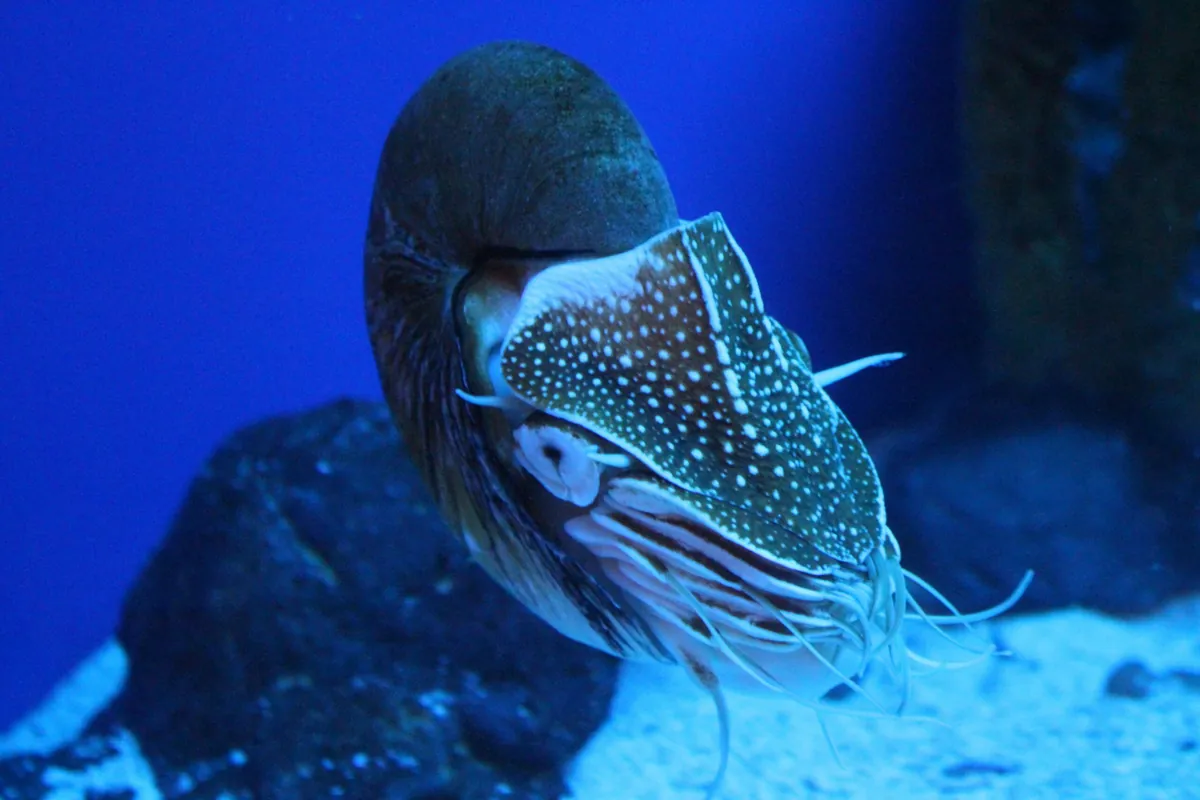
The nautilus is one of the ocean's true living fossils: a coiled, chambered mollusk related to squid and octopuses that has kept much the same body plan for hundreds of millions of years. Found drifting through the deep waters of the Indo-Pacific, it survives on an ancient combination of a gas-filled shell, jet propulsion, and pinhole vision.
Here are the real facts behind this remarkable animal, from its mathematically precise shell to why its slow reproduction puts it at risk today.
The nautilus belongs to the family Nautilidae and order Nautilida, a lineage of shelled cephalopods whose ancestors go back roughly 500 million years, long before the first dinosaurs.
Nautiluses are often called 'living fossils' because their basic shell shape and body plan have changed very little over that vast stretch of time.
The nautilus shell is coiled and divided into internal chambers; the animal lives only in the outermost chamber, while the others are filled with gas that helps it stay buoyant.
Nautiluses regulate their depth by adjusting the gas-to-liquid ratio in these shell chambers through a thin strand of tissue called the siphuncle.
Nautiluses typically live at depths of roughly 100 to 700 meters, most commonly between 150 and 300 meters, and can rupture from water pressure if forced much deeper than about 800 meters.
They often spend daylight hours in deeper water and rise toward reefs at night to feed, a daily vertical migration that helps them avoid predators and find food.
Nautiluses move by jet propulsion, drawing water into their body cavity and forcing it out through a flexible funnel called a hyponome to push themselves, usually backward.
Unlike squid and octopuses, nautiluses have simple pinhole eyes with no lens, so they can sense light and movement but cannot form sharp images.
Nautiluses have roughly 90 small tentacles without suckers, which they use to grasp prey, and a hard beak to crush it.
They are opportunistic scavengers and predators, feeding on shrimp, small fish, and crabs, and can go for long stretches without eating between meals.
Females lay only about 10 to 20 eggs per year, attaching them individually to hard surfaces in relatively shallow, sheltered water.
Nautilus eggs take roughly 8 to 12 months to hatch, one of the longest incubation periods known among marine invertebrates.
Unlike most cephalopods, baby nautiluses hatch fully formed with no separate larval stage.
Nautiluses do not reach sexual maturity until around 10 to 15 years of age, unusually late for a mollusk.
Nautiluses can live more than 20 years, making them far longer-lived than their cephalopod relatives such as squid and octopuses, which typically live only one to a few years.
Their slow growth, late maturity, and low egg output mean nautilus populations recover very slowly once depleted.
Nautilus shells are prized for decoration and jewelry, and unregulated harvesting for the curio trade has driven population declines in parts of their range.
Several nautilus species are now protected under CITES (the Convention on International Trade in Endangered Species of Wild Fauna and Flora), which restricts international trade in their shells.
The nautilus shell's cross-section forms a logarithmic spiral, a mathematically elegant growth pattern that has made it a popular symbol in art, architecture, and design.
Frequently asked questions
How does the nautilus differ from other cephalopods?
Unlike squid and octopuses, the nautilus keeps a hard external shell, has a much simpler nervous system, and lacks the ability to change color or camouflage. It also moves by jet propulsion in a comparatively slow, unsophisticated way.
Why is the nautilus often called a 'living fossil'?
The term is used because the nautilus's overall shell shape and body plan have remained largely similar for hundreds of millions of years, in contrast to most other animal lineages, which have changed dramatically over that time.
What is the significance of the nautilus shell?
The nautilus shell grows in a logarithmic spiral, an efficient and mathematically precise pattern that has long fascinated scientists, artists, and designers, in addition to giving the animal buoyancy control.
How do nautiluses reproduce?
Nautiluses reproduce slowly: females lay only about 10 to 20 eggs a year, attaching them to hard surfaces, and the eggs can take 8 to 12 months to hatch, one of the longest incubation periods of any marine invertebrate.
Are nautiluses endangered?
Several nautilus species are at risk from overharvesting for the ornamental shell trade combined with their naturally slow reproduction, which makes populations slow to recover; some species are now protected under CITES trade restrictions.
How can people help conserve nautiluses?
Avoiding the purchase of nautilus shell products, supporting CITES trade protections, and backing marine conservation efforts in the Indo-Pacific are practical ways to reduce pressure on wild nautilus populations.
We write every article to be genuinely fun — and genuinely true. Each fact is checked against reputable sources before it goes live. Spotted something off? Tell us and read our fact-check policy.