FFacts On Tap Editorial Team Fact-checkedUpdated March 25, 20263 min read
Share
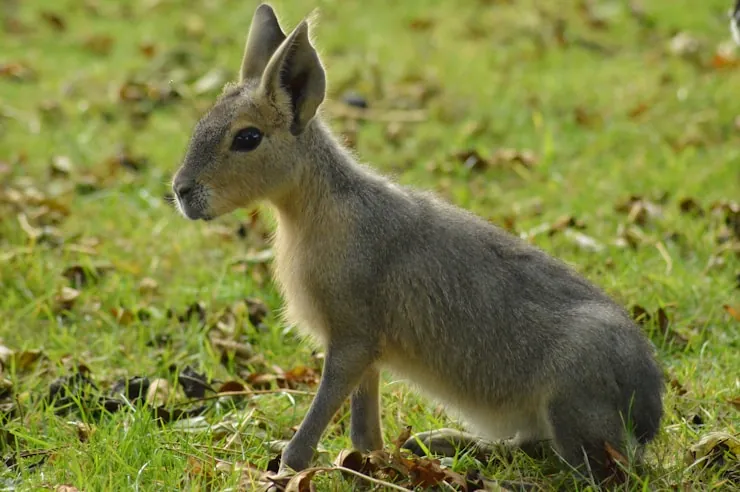
Patagonian maras are often mistaken for long-legged rabbits or small deer, but they're actually giant rodents native to the arid plains of Argentina. With their rabbit-like ears, deer-like legs, and surprisingly loyal social lives, maras are one of South America's most distinctive mammals.
Here's what makes these unusual creatures so fascinating, from their high-speed sprints to their shared nursery burrows.
The Patagonian mara's scientific name is Dolichotis patagonum. It's a rodent, in the same family as guinea pigs and closely related to capybaras.
Maras are among the largest living rodents, with adults typically weighing around 8 to 9 kg (about 17 to 20 pounds) and measuring roughly 27 to 30 inches (69 to 75 cm) long.
They have long, deer-like legs, large rabbit-like ears, and a short tail, giving them an odd hybrid appearance that combines features of several other animals.
Maras are monogamous and form pair bonds that can last for life, with mates staying close together while foraging and traveling.
Pairs communicate through vocal calls and visual signals to coordinate movement and warn each other of nearby predators.
Maras live in the arid grasslands and scrublands of central and southern Argentina, including the Patagonian steppe, where open terrain helps them spot danger early.
Their diet is entirely herbivorous, consisting mainly of grasses, herbs, and fruit, and they get much of the water they need directly from these plants.
Unlike most burrowing rodents, maras usually don't dig their own burrows; they shelter in ones abandoned by other animals, such as viscachas or armadillos.
Breeding peaks in spring and summer. After a gestation period of roughly 90 to 100 days, females typically give birth to one to three well-developed young.
Maras have a unique communal breeding system: several pairs share a single den burrow, dropping off their young together to be guarded collectively while parents forage nearby.
Mara pups are precocial, born furred and mobile with open eyes, and can follow their parents shortly after birth.
The IUCN Red List classifies the Patagonian mara as Near Threatened, with populations declining due to habitat loss from agriculture and ranching, as well as hunting.
Maras are built for speed, able to run at roughly 45 km/h (about 28 mph) in short bursts to outrun foxes and other predators.
When alarmed, maras can also perform a stiff-legged, bouncing gait called "stotting," similar to behavior seen in some deer and antelope.
In the wild, maras typically live around 10 to 14 years; in zoos, with veterinary care and no predators, they often reach the higher end of that range or beyond.
Frequently asked questions
How long do Patagonian maras live?
Patagonian maras typically live about 10 to 14 years in the wild, and can live comparably long or longer in zoos with veterinary care.
Can Patagonian maras be kept as pets?
Not realistically. Maras need large open space, a compatible mate, and specialized care, so they're kept in zoos and wildlife parks rather than as household pets.
What predators threaten Patagonian maras?
Foxes and birds of prey are their main natural predators, while habitat destruction and hunting by humans pose the biggest overall threat to the species.
Are Patagonian maras endangered?
They're classified as Near Threatened by the IUCN, meaning they aren't currently endangered but are at risk if habitat loss and hunting continue.
What is unique about mara social structure?
Maras are monogamous and pair for life, yet several pairs also share communal den burrows where they raise their pups together for added protection from predators.
How fast can a Patagonian mara run?
Maras can run at roughly 45 km/h (about 28 mph), a key defense that helps them escape foxes and other predators on the open steppe.
We write every article to be genuinely fun — and genuinely true. Each fact is checked against reputable sources before it goes live. Spotted something off? Tell us and read our fact-check policy.