FFacts On Tap Editorial Team Fact-checkedUpdated March 26, 20263 min read
Share
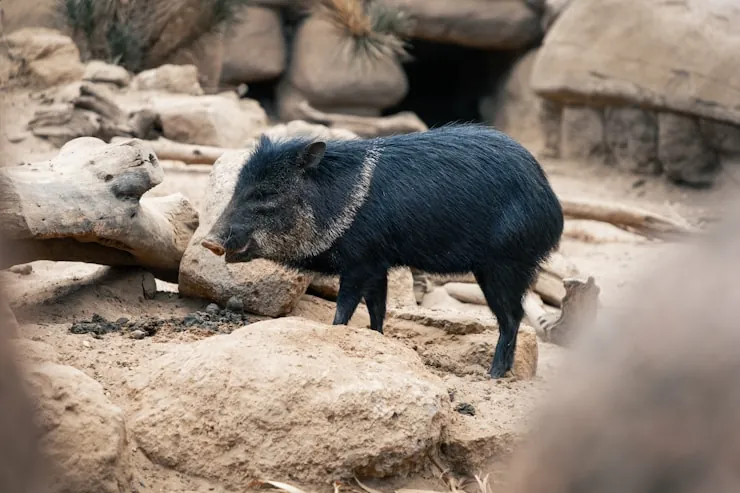
Peccaries, often nicknamed javelinas or skunk pigs, are pig-like mammals native to the Americas. Though they resemble wild boars, peccaries belong to their own family and have a distinct evolutionary history, unique social habits, and a place of their own in the folklore of the Americas.
From chattering herds to a pungent scent gland used for communication, here are the real facts behind these often-misunderstood animals.
There are three living species of peccary: the collared peccary (Pecari tajacu), the white-lipped peccary (Tayassu pecari), and the Chacoan peccary (Catagonus wagneri).
The collared peccary is the most widespread species, ranging from the southwestern United States down through Central America into northern Argentina, and is well adapted to arid, desert-like habitats.
The white-lipped peccary lives mainly in the tropical rainforests of Central and South America and depends on large tracts of intact forest to survive.
Peccaries are highly social animals. Collared peccaries typically travel in small herds of about 6 to 12 individuals, while white-lipped peccaries form much larger herds that can range from 50 to several hundred animals.
Peccaries are omnivores that mainly eat fruit, roots, tubers, cacti, and seeds, occasionally supplementing their diet with insects, small vertebrates, or carrion.
Peccaries have a keen sense of smell, which they rely on more than eyesight to locate food buried underground and to detect predators.
Jaguars, pumas, and humans are the main predators of adult peccaries, while young peccaries are also vulnerable to smaller predators like ocelots and large birds of prey.
Habitat loss from deforestation and agricultural expansion, along with hunting, are the biggest threats to peccary populations across their range.
Peccaries communicate through a range of grunts, barks, and teeth-chattering clicks that help coordinate herd movement and signal alarm.
Female peccaries usually give birth to one or two young after a gestation period of roughly 145 to 160 days, depending on the species.
Young peccaries are precocial, meaning they are born well-developed, with open eyes and the ability to walk and follow the herd within hours of birth.
Peccaries have a large scent gland near the base of the tail on their lower back that secretes a strong, musky odor used to mark territory and help herd members recognize one another, which is the source of the 'skunk pig' nickname.
The Chacoan peccary is classified as Endangered by the IUCN, with a total wild population estimated at only around 3,000 animals threatened by habitat loss in the Gran Chaco region.
Peccaries have been culturally significant to many Indigenous peoples of the Americas for centuries, appearing in folklore, hunting traditions, and art.
Unlike true pigs, peccaries have a simple, non-curving set of tusks that point straight down rather than curling outward, and they belong to a separate family, Tayassuidae.
Peccaries play an important ecological role as seed dispersers and soil aerators, and their rooting behavior while foraging helps shape plant communities in their habitats.
Frequently asked questions
What do peccaries eat?
Peccaries are omnivores that mainly eat fruit, roots, tubers, and cacti, occasionally eating insects, small animals, or carrion when available.
How long do peccaries live?
In the wild, collared peccaries typically live around 8 to 10 years, though in captivity with proper care they can live up to 24 years.
Are peccaries dangerous to humans?
Peccaries are generally not aggressive toward humans and will usually flee if startled, but a herd can act defensively if it feels cornered or threatened, so it's best to keep a respectful distance.
Can peccaries be domesticated like pigs?
No. Peccaries are wild animals with specific social and ecological needs, and unlike domestic pigs they have not been selectively bred for life alongside humans.
How can peccaries be distinguished from wild boars?
Peccaries are smaller than wild boars, have straight (non-curving) tusks, a scent gland on their lower back, and different social structures, and they belong to an entirely separate mammal family.
Why are peccaries important to the ecosystem?
Peccaries help disperse seeds, aerate soil through foraging, and serve as prey for large predators like jaguars, making them an important part of the food web in their native habitats.
We write every article to be genuinely fun — and genuinely true. Each fact is checked against reputable sources before it goes live. Spotted something off? Tell us and read our fact-check policy.