FFacts On Tap Editorial Team Fact-checkedUpdated April 8, 20263 min read
Share
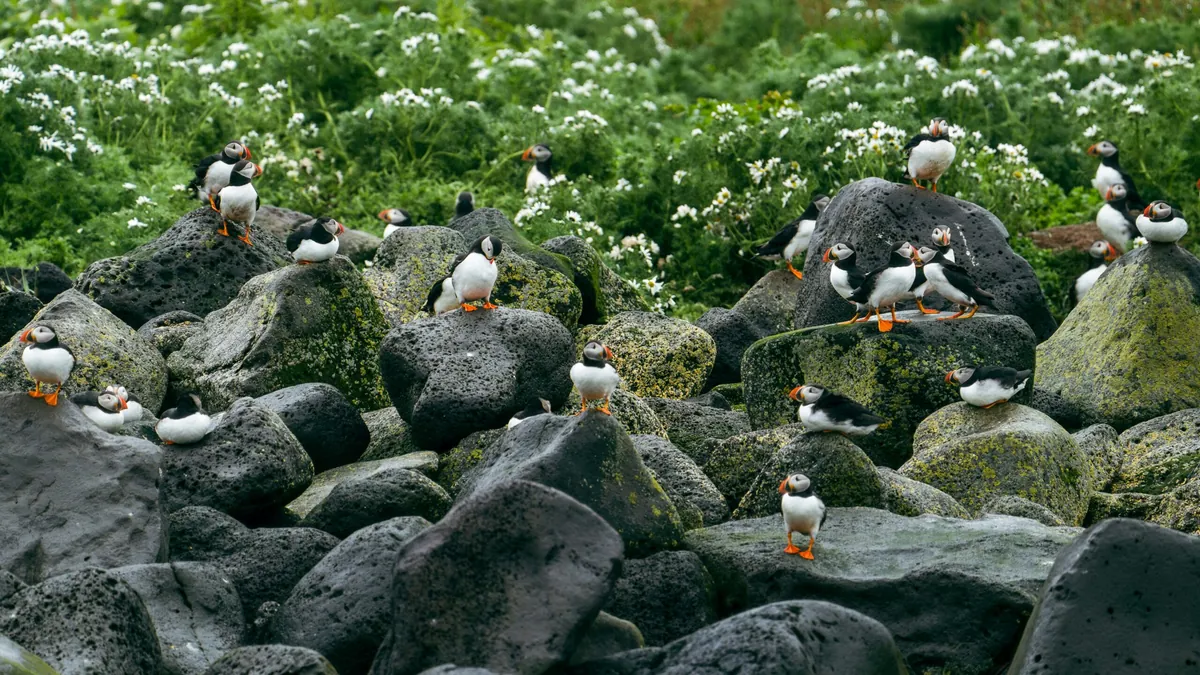
Puffins are often called the "clowns of the sea" thanks to their bright orange beaks and comical waddling gait. But behind the charm is a seabird built for a tough life: expert diving, underground nesting, and months alone on the open ocean.
Here are the real facts behind these beloved birds, verified against ornithology and conservation sources.
There are three species of puffin: the Atlantic puffin (Fratercula arctica), the horned puffin (Fratercula corniculata), and the tufted puffin (Fratercula cirrhata), found across the North Atlantic and North Pacific oceans.
Puffins' beaks are famously bright orange with patches of blue-grey, and the color intensifies during the breeding season to help attract mates before fading in winter.
Puffins nest in enormous cliff-top and island colonies, sometimes numbering in the hundreds of thousands; Iceland alone hosts more than 60% of the world's Atlantic puffins.
Puffins feed mainly on small fish like sand eels, herring, and capelin, and are strong underwater swimmers, using their wings to "fly" through the water in pursuit of prey.
Atlantic puffins can dive to depths of around 60 meters (about 200 feet), though most dives are far shallower, typically lasting 20 to 30 seconds.
Puffins can carry a dozen or more small fish crosswise in their beaks at once, thanks to backward-pointing spines on their tongue and palate that grip each new fish as it's caught.
Unlike most seabirds, puffins nest underground in burrows they dig themselves or take over from other animals like rabbits, laying a single egg per season deep inside for protection.
Puffins are long-lived for their size, with many reaching 20 years or more in the wild; banding studies have recorded individuals living past 30 years.
Puffins typically don't breed until they are about 5 years old, and pairs are largely monogamous, often reuniting at the same burrow with the same partner year after year.
After breeding season ends, puffins head out to spend the winter alone on the open ocean, sometimes traveling thousands of miles, and their beak colors dull during this time.
Puffins are mostly silent on land but make low growling and grunting calls at sea and inside their nesting burrows as part of social and mating communication.
Puffins have waterproof feathers and webbed feet, adaptations that keep them warm and dry while making them agile swimmers and divers.
Climate change, overfishing, and pollution are major threats to puffins, since shifting sea temperatures can reduce the small fish populations puffins depend on to feed their chicks.
Conservation groups such as the National Audubon Society have worked to protect puffin colonies, most notably through Project Puffin, which helped restore breeding populations on islands off the coast of Maine.
Frequently asked questions
What is the lifespan of a puffin?
Puffins commonly live 20 years or more in the wild, and banding records have documented individuals surviving past 30 years.
How can puffins hold multiple fish in their beaks at once?
Backward-facing spiny structures on a puffin's tongue and the roof of its mouth grip each fish as it's caught, letting it hold a dozen or more small fish crosswise without dropping earlier catches.
Why do puffins have colorful beaks?
A puffin's beak brightens during breeding season to signal health and attract a mate, then fades in color once the season ends.
Are puffins endangered?
Atlantic puffins are not classified as globally endangered but are listed as vulnerable in parts of their range due to declining numbers, driven largely by changing fish availability and climate impacts.
What do puffins eat?
Puffins mainly eat small forage fish such as sand eels, herring, and capelin, with diet varying by region and season.
How deep can puffins dive?
Atlantic puffins can dive to roughly 60 meters (about 200 feet), though most everyday dives are much shallower and last well under a minute.
We write every article to be genuinely fun — and genuinely true. Each fact is checked against reputable sources before it goes live. Spotted something off? Tell us and read our fact-check policy.