FFacts On Tap Editorial Team Fact-checkedUpdated March 21, 20263 min read
Share
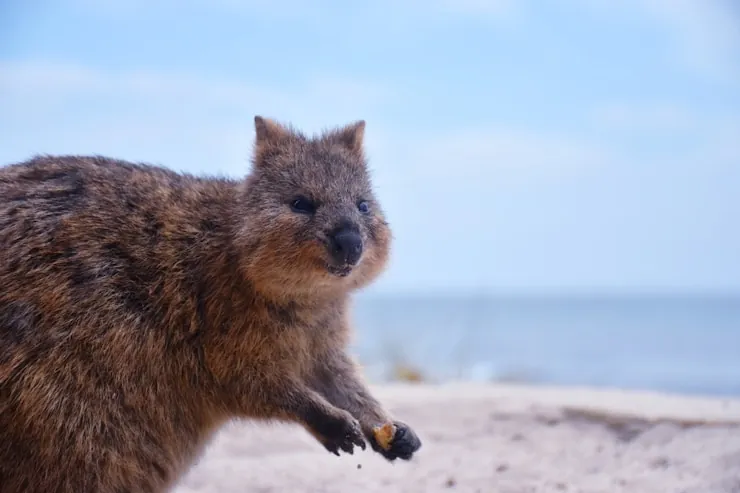
Quokkas, often called the world's happiest animals because of their permanent grin-like expression, are small marsupials native to a tiny corner of southwestern Australia. Cat-sized, curious, and famously unafraid of humans, they've become social-media stars for their selfie-ready smiles.
But there's more to quokkas than cute photos. Here are the real facts about how they live, breed, and survive as a vulnerable species.
Quokkas are marsupials in the genus Setonix, with the scientific name Setonix brachyurus.
They're roughly the size of a domestic cat, with a body length of about 40 to 54 cm (16 to 21 inches) and a tail length of around 25 to 30 cm (9.8 to 11.8 inches).
Their fur is thick and brownish-gray, and their rounded face gives them what looks like a constant smile.
Quokkas are found mainly on Rottnest Island and Bald Island off Western Australia, plus small, scattered populations in mainland bushland near Albany and the southwest.
They prefer dense vegetation for shelter and daytime hiding, and are well adapted to Western Australia's dry climate.
Quokkas are herbivores, feeding mainly on grasses, leaves, and bark, and can go long stretches without drinking by getting moisture from their food.
Gestation lasts about 27 days, after which the female gives birth to a single tiny joey that then lives in her pouch for roughly six months.
Thanks to a reproductive trick called embryonic diapause, quokkas can pause a fertilized embryo's development until the previous joey leaves the pouch, allowing some females to raise two joeys in a year.
Their powerful hind legs help them move quickly through dense scrub, and they can climb low trees and shrubs to reach food.
Quokkas are social animals often seen in small groups, and while mostly nocturnal, they're also active during the day in cooler weather.
The IUCN Red List classifies quokkas as Vulnerable, with habitat loss and predation by introduced foxes and cats as the main threats.
Quokkas became internet-famous for approaching tourists on Rottnest Island and appearing in countless 'quokka selfies.'
It's illegal to touch, feed, or handle quokkas in Australia; they are a protected species, and violators can face significant fines.
Conservation efforts include habitat restoration, predator control programs, and ongoing research into quokka ecology on Rottnest Island and the mainland.
In the wild, quokkas typically live around 10 years; in captivity, with veterinary care and no predators, they can live longer.
Frequently asked questions
How long do quokkas live?
In the wild, quokkas typically live around 10 years. In captivity, with consistent food and no predators, some individuals live longer.
What are the biggest threats to quokka populations?
Habitat loss from land clearing and development, predation by introduced foxes and feral cats, and the effects of a changing climate on their habitat are the main threats.
Can quokkas be kept as pets?
No. Quokkas are a protected species in Australia, and it's illegal to keep, touch, or disturb them. They also aren't suited to domestic life given their specialized diet and habitat needs.
Why do quokkas look like they're smiling?
The 'smile' comes from the natural shape of their facial muscles and jaw, not from an actual emotional expression. It just happens to look cheerful to us.
How do quokkas reproduce?
Quokkas use embryonic diapause, a strategy where a fertilized embryo's development pauses until the current joey leaves the pouch. This lets some females raise more than one joey per year when conditions are good.
Are there successful conservation programs for quokkas?
Yes. Predator control and habitat restoration programs on Rottnest Island and in mainland reserves have helped stabilize some quokka populations, though the species remains classified as Vulnerable.
We write every article to be genuinely fun — and genuinely true. Each fact is checked against reputable sources before it goes live. Spotted something off? Tell us and read our fact-check policy.