FFacts On Tap Editorial Team Fact-checkedUpdated March 20, 20264 min read
Share
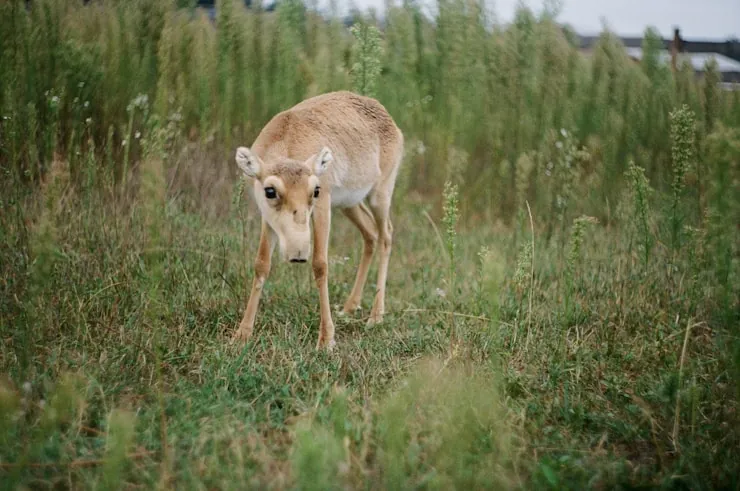
With a bulbous, trunk-like nose and a lineage stretching back to the last Ice Age, the saiga antelope is one of the strangest and toughest survivors on the Eurasian steppe. Native to the grasslands of Kazakhstan, Russia, Mongolia, and Uzbekistan, this small antelope has weathered mass die-offs and a poaching crisis that nearly wiped it out.
Its story took a dramatic turn in recent years: after decades as one of the world's most endangered mammals, the saiga has staged one of the fastest population recoveries ever recorded for a large mammal.
Saigas are best known for their oversized, flexible nose, which hangs down over the mouth and acts like a built-in air filter and radiator, warming and moistening cold, dusty winter air and cooling the animal in summer.
During the last Ice Age, saigas ranged across the mammoth steppe from the British Isles all the way to Alaska and parts of the Yukon, crossing the Bering land bridge tens of thousands of years ago before dying out in North America as the climate warmed.
Today saigas survive only in fragmented pockets of Kazakhstan, Russia, Mongolia, and Uzbekistan, a tiny remnant of their former Ice Age range.
Saiga populations have swung wildly over the past century: healthy herds in the millions existed in parts of the 20th century, but after the collapse of the Soviet Union in the early 1990s, rampant poaching for horns and meat caused a crash of roughly 95 percent within about a decade, one of the fastest declines ever recorded for a mammal.
Only male saigas grow horns, and demand for those horns in traditional medicine markets, mainly in China, was the main driver of the poaching crisis.
Because poachers targeted horned males, the sex ratio in some herds became so skewed that females struggled to find mates, pushing several populations toward reproductive collapse.
Saigas reach sexual maturity remarkably young: females can begin breeding at around eight months old, and many give birth to twins each spring.
Despite breeding so early, wild saigas typically live only 6 to 10 years.
Saigas are herbivores that graze on grasses, herbs, and shrubs, including some plants that are toxic to other animals.
They favor open, flat steppe and semi-desert habitat, which lets them spot approaching wolves and other predators from a distance.
Saigas are among the great migratory mammals, traveling in herds of thousands across hundreds of kilometers between summer and winter pastures each year.
They are also one of the fastest antelopes, capable of running at speeds over 60 km/h (about 37 mph) to escape predators.
Saigas are highly vulnerable to disease outbreaks: in 2015, a bacterial infection called pasteurellosis killed more than 200,000 saigas in Kazakhstan in just a few weeks, roughly two-thirds of the entire global population at the time.
In December 2023, the IUCN Red List reclassified the saiga antelope from Critically Endangered to Near Threatened, after Kazakhstan's population rebounded from under 40,000 in 2005 to well over a million, thanks to strict anti-poaching enforcement and habitat protection.
Despite that recovery, conservationists warn the Near Threatened status could slip again quickly without continued protection, since smaller populations in Russia, Mongolia, and Uzbekistan remain far more fragile than Kazakhstan's.
Saigas have long been part of the cultural and economic life of Central Asian steppe communities, historically used for meat and hides, with modern efforts working to balance those traditions with conservation.
Ongoing scientific monitoring, including satellite tracking and genetic studies, helps researchers follow saiga migrations and disease risks and guide conservation decisions across their range.
Frequently asked questions
What is the primary diet of saigas?
Saigas are herbivores that graze on grasses, herbs, and shrubs across the open steppe, adjusting their diet seasonally based on what vegetation is available.
Are saigas still critically endangered?
No. In December 2023, the IUCN Red List moved the saiga antelope from Critically Endangered to Near Threatened after major population recoveries in Kazakhstan, though some smaller regional populations remain vulnerable.
How do saigas adapt to their environment?
Their most famous adaptation is their large, flexible nose, which filters dust and helps regulate body temperature in both freezing winters and hot summers on the open steppe.
Did saigas ever live outside of Asia?
Yes, but only during the last Ice Age. Fossil evidence shows saigas ranged from the British Isles across Eurasia and over the Bering land bridge into Alaska and parts of Canada before dying out in North America around 10,000 to 13,000 years ago.
What caused the saiga population crash in the 1990s?
After the collapse of the Soviet Union, widespread poverty and a booming trade in male saiga horns for traditional medicine led to intense poaching, which cut populations by around 95 percent within about ten years.
What is being done to conserve saigas today?
Conservation work includes anti-poaching patrols, habitat protection, disease monitoring, and international cooperation among Kazakhstan, Russia, Mongolia, and Uzbekistan, which together drove the species' recent recovery.
We write every article to be genuinely fun — and genuinely true. Each fact is checked against reputable sources before it goes live. Spotted something off? Tell us and read our fact-check policy.