FFacts On Tap Editorial Team Fact-checkedUpdated June 29, 20264 min read
Share
Sloths are famous for moving in slow motion, but there's a lot more going on beneath that laid-back exterior. From a digestive system that can take a month to process a single leaf to a built-in ecosystem living in their fur, sloths are some of the strangest survival stories in the animal kingdom.
Here are fact-checked facts about sloths, including a few myths worth clearing up.
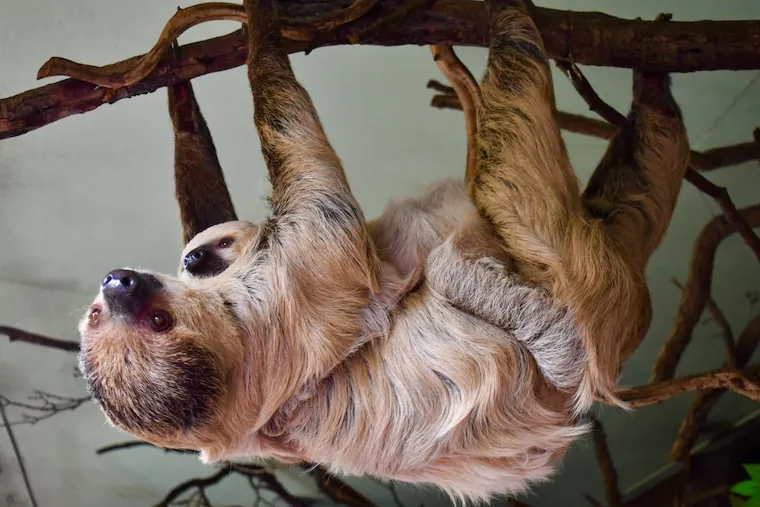
Sloths are arboreal animals, meaning they spend nearly all their lives in trees, only descending to the ground about once a week.
There are two living groups of sloths: two-toed sloths (genus Choloepus) and three-toed sloths (genus Bradypus).
Sloths have an unusually low metabolic rate, which is a big part of why they move so slowly and conserve energy.
Sloths are surprisingly good swimmers and can slow their heart rate to hold their breath for up to 40 minutes underwater.
A sloth's fur hosts its own miniature ecosystem, including algae, moths, beetles, and fungi living in the grooves of each hair.
Sloths have such a slow digestive system that a single meal can take up to a month to fully break down.
Sloths sleep roughly 8 to 10 hours a day in the wild (captive sloths studied earlier were thought to sleep far more, up to 15-20 hours), and they are most active at night.
Sloths have long, curved claws that they use to grip tree branches and defend themselves when threatened.
Three-toed sloths have extra neck vertebrae that let them rotate their heads about 270 degrees, giving them an owl-like range of motion.
Sloths have specialized digestive systems that help them tolerate the mild toxins found in the rainforest leaves they eat.
Sloths are solitary animals and mostly come together only to mate.
Sloths communicate with soft hisses and, in some species, distinctive calls; mother and baby sloths bond partly through scent and touch.
A greenish tint sometimes seen in sloth fur comes from the algae growing in it, which helps camouflage them among the leaves.
Sloths have naturally slow, variable heart rates, and their heartbeat can drop into the range of 30 beats per minute or lower while at rest to save energy.
Sloths and the moths living in their fur have a symbiotic relationship: the moths lay eggs in the sloth's dung, and the larvae later find their way back into the sloth's fur.
On the ground, sloths can't walk well and instead drag themselves along using their claws, moving far more efficiently in trees than on the forest floor.
Gestation length differs by species: three-toed sloths carry their young for about 6 months, while two-toed sloths have a much longer pregnancy of roughly 11 to 12 months. Sloths typically give birth to a single offspring.
A sloth's low body temperature, often in the mid-70s to low-90s Fahrenheit, can shift with the surrounding air temperature since sloths regulate heat less precisely than most mammals.
Sloths can live around 20 years in the wild, and captive sloths have been known to live considerably longer.
Not all sloths are equally at risk: most sloth species are listed as Least Concern by the IUCN, but the maned three-toed sloth is Vulnerable and the pygmy three-toed sloth, found only on one small Panamanian island, is Critically Endangered.
Sloths are protected under wildlife laws in most of their native range, and capturing or harming them is illegal in many countries.
Sloths are excellent at climbing and hanging thanks to specialized tendons that let them grip branches with almost no muscular effort, even while sleeping.
Frequently asked questions
What do sloths eat?
Sloths primarily eat leaves, along with some fruits and flowers, and their slow gut takes weeks to break the tough plant matter down.
Do sloths move slowly all the time?
Yes, sloths move slowly almost all the time to conserve energy, though they can move a bit faster when swimming or reacting to danger.
Are sloths endangered?
It depends on the species. Most sloth species are Least Concern, but the maned three-toed sloth is Vulnerable and the pygmy three-toed sloth is Critically Endangered.
Can sloths swim?
Yes, sloths are strong swimmers and can hold their breath for up to about 40 minutes underwater.
Do sloths make good pets?
No, sloths are wild animals with specialized diets and slow metabolisms that make them unsuitable as pets, and owning one is illegal in most places without a special permit.
How long do sloths live?
Sloths typically live around 20 years in the wild, with some captive sloths living significantly longer.
We write every article to be genuinely fun — and genuinely true. Each fact is checked against reputable sources before it goes live. Spotted something off? Tell us and read our fact-check policy.