FFacts On Tap Editorial Team Fact-checkedUpdated February 17, 20263 min read
Share
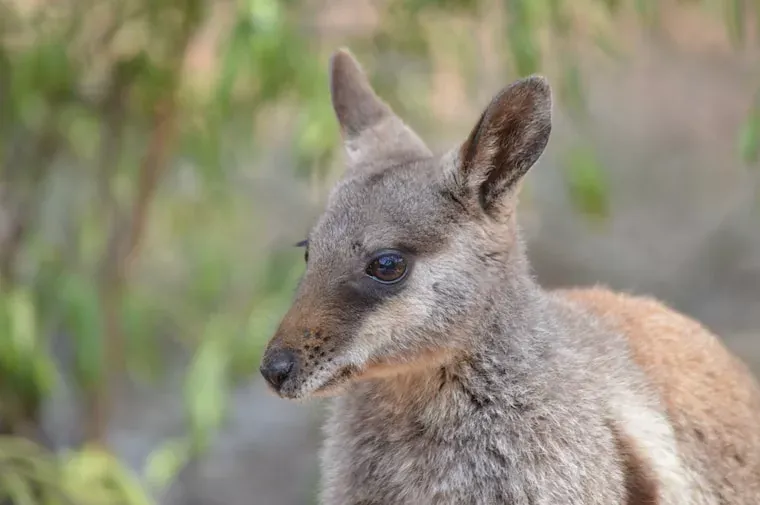
Wallabies are small-to-medium marsupials found across Australia and New Guinea, easily recognized by their powerful hind legs, oversized ears, and hopping gait. Often mistaken for miniature kangaroos, they actually belong to several different genera within the same family, macropodidae.
From pouch-raised joeys to record-setting leaps, here are the real, verified facts behind one of Australia's most iconic animals.
Wallabies are macropods, a name derived from the Greek words for "big foot." They belong to the same family, Macropodidae, as kangaroos and wallaroos.
There are roughly 30 recognized wallaby species (estimates range higher depending on classification), including brush wallabies, rock-wallabies, hare-wallabies, and pademelons.
Wallabies are herbivores that graze mainly on grasses, leaves, and other vegetation.
Like kangaroos, wallabies use foregut fermentation, regurgitating and re-chewing partially digested plant matter to help break down tough fibers.
Large wallaby species can leap as high as 3 meters (about 10 feet) and cover several meters in a single bound, using their powerful hind legs.
A wallaby's thick tail acts as a counterbalance while hopping and can also support the animal's weight when standing still.
Wallabies have large ears that rotate independently, helping them detect predators from many directions at once.
They have good color vision, which helps them spot ripe food sources among vegetation.
Many wallaby species are social and live in loose groups sometimes called mobs.
Female wallabies carry their young, called joeys, in a forward-facing pouch for several months after birth.
A newborn joey is tiny, blind, and hairless, and it climbs unaided into the mother's pouch to continue developing while nursing.
Some wallaby species can delay development of a fertilized embryo during droughts or food shortages, a phenomenon called embryonic diapause.
Most wallabies are most active at dusk, dawn, or night (crepuscular or nocturnal), resting in shade during the heat of the day.
Wallabies rely heavily on smell and hearing to detect predators and other wallabies nearby.
Many species mark territory using scent glands, especially around the chest and cheeks.
Their fur provides insulation and helps regulate body temperature across a range of climates, from alpine areas to woodlands.
Depending on the species, wild wallabies commonly live around 7 to 14 years, and can live longer, sometimes past 15 years, in captivity with good care.
Natural predators include dingoes, introduced red foxes, feral cats, large birds of prey, and, for smaller species, snakes.
Historically hunted for meat and fur, many wallaby populations have since stabilized or recovered thanks to conservation and management programs.
Several rock-wallaby species are listed as vulnerable or endangered due to habitat loss, introduced predators, and competition from feral herbivores.
Wallabies are popular attractions in Australian wildlife parks and zoos, and some species have even established wild populations overseas, such as on the Isle of Man and in parts of New Zealand.
Their hopping gait is remarkably energy-efficient at speed, letting them cover long distances while conserving energy compared to running on four legs.
Frequently asked questions
What is the difference between a wallaby and a kangaroo?
Wallabies are generally smaller than kangaroos, with shorter legs, smaller feet, and often shorter, rounder faces. Wallabies also tend to favor wooded or shrubby habitat, while kangaroos are more associated with open grasslands.
Why do wallabies have pouches?
The pouch lets female wallabies carry and protect their extremely underdeveloped newborn joey. Inside, the joey stays attached to a teat, nursing and continuing to develop in a warm, secure space for months.
What is the lifespan of a wallaby?
It varies by species, but wild wallabies commonly live around 7 to 14 years, while captive wallabies can live longer, sometimes into their mid-to-late teens, with consistent food and no predators.
How many species of wallabies are there?
There are roughly 30 commonly recognized wallaby species, though the exact count varies by source depending on how closely related genera like rock-wallabies and pademelons are classified.
What are wallabies' predators?
Natural and introduced predators include dingoes, red foxes, feral cats, and large birds of prey; smaller wallaby species can also fall prey to snakes.
Are wallabies endangered?
Not as a whole group. Most wallaby species are considered stable, but several, particularly some rock-wallaby species, are listed as vulnerable or endangered due to habitat loss and introduced predators.
We write every article to be genuinely fun — and genuinely true. Each fact is checked against reputable sources before it goes live. Spotted something off? Tell us and read our fact-check policy.