Some facts are scary because they're real, and some are scary because nobody has ever been able to explain them. This list has both: deadly creatures and places that actually exist, plus decades-old mysteries that still have no confirmed answer.
We checked every claim below and corrected or cut the ones that didn't hold up, so you can get your chills without getting misled.
Overtoun Bridge in Scotland has been the site of at least 50 confirmed dog deaths since the 1950s, with hundreds more dogs reported to have jumped and survived. Researchers now believe the strong scent of mink living beneath the bridge draws dogs to leap over the parapet.
Rats have flexible, collapsible skeletons and can squeeze through gaps as small as a quarter-sized hole.
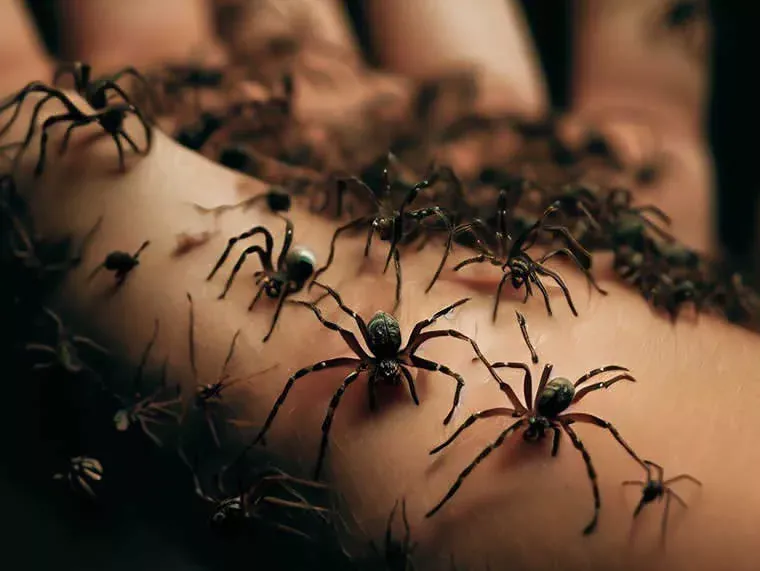
Spider populations vary enormously by habitat, but studies estimate anywhere from tens of thousands per acre in forests to a few million per acre in grasslands and tropical fields.
Naegleria fowleri, a "brain-eating amoeba," can enter the body through the nose during swimming in warm freshwater and cause a rare, usually fatal brain infection called primary amoebic meningoencephalitis.
The Catacombs of Paris hold the remains of more than six million people, making it one of the largest underground ossuaries in the world.
Sleep paralysis is a real condition in which a person temporarily can't move or speak while falling asleep or waking up, often accompanied by vivid, frightening hallucinations.
The Great Pacific Garbage Patch is a sprawling accumulation of floating plastic debris in the North Pacific Ocean, with some estimates putting its area at roughly twice the size of Texas.
The death cap mushroom (Amanita phalloides) is one of the most lethal fungi on Earth; a small bite can cause fatal liver and kidney failure if untreated.
Within days of death, the body's own digestive enzymes begin breaking down its tissues, a process called autolysis, marking the start of decomposition.
The Asian giant hornet, nicknamed the "murder hornet," can grow up to 2 inches long and delivers an unusually painful sting; multiple stings can be dangerous, especially for people who are allergic.
The fungus Ophiocordyceps unilateralis infects certain ants, hijacking their behavior so they climb to an ideal spot before the fungus kills them and sprouts spores from their bodies.
More than 500,000 pieces of tracked debris are orbiting Earth, some traveling fast enough that even fragments the size of a marble can seriously damage a satellite.
Capgras delusion is a rare psychiatric condition in which a person becomes convinced that a close friend or family member has been replaced by an identical impostor.
Fatal Familial Insomnia is an extremely rare inherited prion disease that causes progressively worsening insomnia, hallucinations, and, eventually, death, with no known cure.
The Bolton Strid in England looks like a shallow, gentle stream but hides a violent, churning underwater current that has claimed numerous lives.
Turkmenistan's "Door to Hell" gas crater has been burning since 1971 after a Soviet-era drilling accident; despite government efforts in recent years to seal or extinguish it, the fire has only been reduced, not put out.
Lake Kivu, on the border of Rwanda and the Democratic Republic of Congo, holds huge amounts of dissolved methane and carbon dioxide, raising concern about a rare but catastrophic gas-release event.
In 1959, nine experienced hikers died under circumstances that remain unexplained in Russia's Ural Mountains, an event now known as the Dyatlov Pass Incident.
In 1518, hundreds of people in Strasbourg were struck by an outbreak of uncontrollable dancing that lasted for days, with some dancers reportedly dying from exhaustion; historians still debate the cause.
In 1922, six people were murdered on the Hinterkaifeck farm in Germany in a case that remains unsolved a century later, with no confirmed motive or suspect.
In 1872, the ship Mary Celeste was found adrift in the Atlantic, fully seaworthy but with its entire crew missing; their disappearance has never been conclusively explained.
More than 100 settlers vanished from the Roanoke Colony in present-day North Carolina in the late 1580s, leaving behind the word "CROATOAN" carved into a post and one of history's most enduring unsolved mysteries.
In 1908, a massive explosion over Siberia's Tunguska region flattened an estimated 800 square miles of forest; scientists believe it was caused by an asteroid or comet fragment exploding in the atmosphere.
The Voynich Manuscript is an illustrated book, likely created in the early 15th century, written in an unknown script that no scholar or codebreaker has ever deciphered.
The 1947 murder of aspiring actress Elizabeth Short, known as the "Black Dahlia," remains one of Los Angeles's most infamous unsolved homicides.
The Mothman is a legendary creature said to have been sighted around Point Pleasant, West Virginia, in the mid-1960s, shortly before the deadly collapse of the Silver Bridge in 1967; it remains a folklore staple rather than a documented animal.