FFacts On Tap Editorial Team Fact-checkedUpdated March 1, 20263 min read
Share
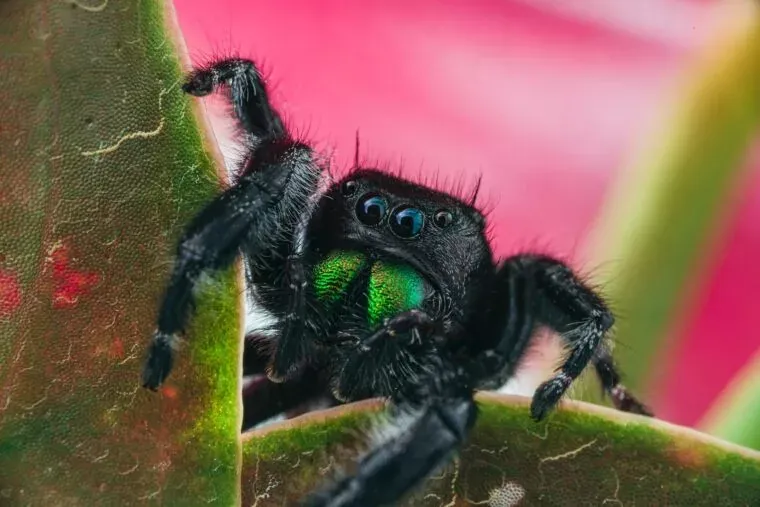
Jumping spiders (family Salticidae) are the acrobats of the arachnid world. With eight eyes, a fuzzy coat, and springy legs, they stalk prey like tiny cats instead of waiting in a web. It's also the largest spider family on Earth, with thousands of species found on every continent except Antarctica.
They're also one of the most-quoted spiders on the internet, which means plenty of the "facts" about them online are exaggerated or just wrong. Here's what's actually verified.
Jumping spiders belong to the family Salticidae, the largest spider family in the world, with roughly 6,000 to 7,000 described species across more than 600 genera.
They have eight eyes arranged in four pairs, including two large forward-facing principal eyes that give them sharp, detailed vision.
Many jumping spiders can leap up to 50 times their own body length, powered by a rapid surge of blood (hemolymph) pressure into their legs rather than by leg muscles alone.
Jumping spiders don't rely on binocular vision like humans do for depth perception. A 2012 study found that a single principal eye can judge distance using 'image defocus,' where mismatched focus across layers of the retina reveals how far away an object is.
Some species, such as Habronattus, can see ultraviolet light, letting them detect UV markings on flowers and on each other that are invisible to human eyes.
Jumping spiders communicate through vibration, drumming and shaking their bodies to send seismic signals across leaves and other surfaces during courtship and territorial encounters.
The idea that jumping spiders recognize themselves in a mirror is not supported by rigorous testing; true mirror self-recognition has only been convincingly shown in a small number of animals, none of them spiders.
Jumping spiders do have real recognition abilities: Portia labiata females can tell their own silk draglines apart from those of other spiders, and Phidippus regius has been shown to recognize individual spiders it has met before.
Jumping spiders do produce venom to subdue their insect prey, but it is not dangerous to humans; bites are rare and, if they happen, typically cause only minor, temporary irritation.
Unlike many spiders, jumping spiders don't build webs to catch prey. They stalk and pounce on their targets, though they still spin silk for safety lines and small nest-like retreats.
Bagheera kiplingi, a jumping spider found in Central America, gets most of its diet from plant matter rather than insects, making it one of the very few largely herbivorous spiders known to science.
Jumping spiders live on nearly every continent and in habitats ranging from deserts to rainforest canopies. Euophrys omnisuperstes, found high in the Himalayas, is among the highest-altitude permanent animal residents ever recorded.
Some coastal jumping spiders, like New Zealand's Marpissa marina, live along rocky, wave-splashed shorelines and can survive brief submersion, but no jumping spider species lives permanently underwater.
Jumping spiders have distinctive, often colorful markings that vary widely by species, and males of many species perform elaborate visual courtship dances to attract females.
Frequently asked questions
Are jumping spiders dangerous to humans?
No. Jumping spiders do have venom to subdue insect prey, but it poses no real danger to humans. Bites are rare, and any reaction is typically mild and short-lived.
How many species of jumping spiders are there?
Salticidae, the jumping spider family, includes roughly 6,000 to 7,000 described species, making it the largest family of spiders in the world.
Can jumping spiders recognize themselves in a mirror?
There's no solid scientific evidence for that. Studies instead show jumping spiders can recognize their own silk draglines and remember individual spiders they've encountered before.
How do jumping spiders communicate with each other?
They communicate using vibrations, drumming and shaking their legs and bodies to send seismic signals through leaves and other surfaces, often during courtship or territorial disputes.
How far can a jumping spider jump?
Many jumping spiders can leap up to 50 times their own body length, using a rapid hydraulic pressure surge in their legs rather than muscle contraction alone.
How do jumping spiders see so well?
They have four pairs of eyes, including two large principal eyes with sharp resolution. Some species can even judge distance using image defocus from a single eye, without needing binocular vision.
We write every article to be genuinely fun — and genuinely true. Each fact is checked against reputable sources before it goes live. Spotted something off? Tell us and read our fact-check policy.