FFacts On Tap Editorial Team Fact-checkedUpdated July 18, 20253 min read
Share
Koalas are among the most beloved animals on Earth, famous for their round faces and laid-back nature. But behind that sleepy image is a highly specialized marsupial built for a narrow, toxic diet and a very particular way of life.
Here are verified facts about koalas, from their odd digestion to their surprisingly human-like fingerprints.
Koalas are native to Australia, found in eucalyptus forests along the eastern and southern coast in Queensland, New South Wales, Victoria, and South Australia.
Despite the nickname 'koala bear,' koalas are not bears at all — they are marsupials, meaning females carry and nurse their young in a pouch.
Koalas are herbivores that feed almost exclusively on eucalyptus leaves, which are toxic and low in nutrition for most other animals.
A koala's digestive system includes an enlarged cecum where specialized gut bacteria ferment eucalyptus leaves and neutralize their toxic compounds.
Koalas sleep an average of 18 to 22 hours a day, largely to conserve the limited energy they get from their low-calorie eucalyptus diet.
Koalas are most active at dusk, night, and dawn (crepuscular/nocturnal behavior) rather than during the heat of the day.
Male koalas produce a deep, resonant 'bellow' — a sound far lower-pitched than their small size would suggest — to advertise their size and location to rivals and mates.
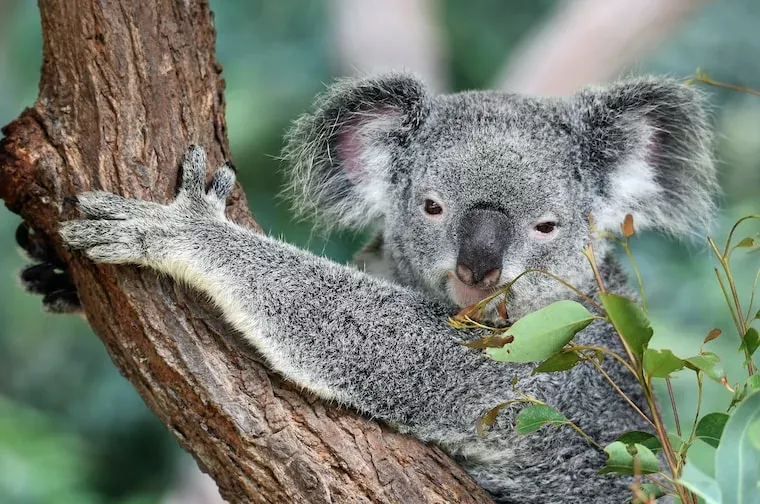
Koalas have two opposable digits on each front paw, giving them a strong pincer-like grip that's ideal for climbing eucalyptus trunks.
The pads of a koala's paws are covered in ridged skin patterns very similar to human fingerprints — so similar that they have occasionally complicated forensic evidence at crime scenes in Australia.
Koalas have thick, woolly fur that insulates them against both summer heat and winter cold, and helps shed rain.
Koalas typically live around 10 to 15 years in the wild, with females often living longer than males; in captivity, with no predators or vehicle strikes, they can live to 20 years or more.
Koalas rarely need to drink standing water because they get most of their hydration from the moisture in eucalyptus leaves.
The IUCN Red List classifies the koala as a globally 'vulnerable' species, but in February 2022 the Australian government uplisted koala populations in Queensland, New South Wales, and the ACT to 'endangered' due to sharp regional declines.
Habitat loss, bushfires, disease (notably chlamydia), dog attacks, and vehicle strikes are the leading threats to koala populations.
Wild koala numbers are difficult to pin down precisely; recent estimates from the Australian Koala Foundation put the population at under 100,000, with some regional estimates as low as roughly 40,000 to 60,000.
Frequently asked questions
How many koalas are left in the wild?
Estimates vary widely by source and region, but the Australian Koala Foundation puts the total wild population at under 100,000, with some regional estimates as low as 40,000-60,000 due to habitat loss and bushfires.
Can koalas be kept as pets?
No. It is illegal to keep a koala as a pet anywhere in Australia; they are a protected native species that can only be cared for by licensed zoos, sanctuaries, and wildlife carers.
Do koalas drink water?
Koalas get most of their moisture from eucalyptus leaves and rarely need to drink, but they will drink water directly when it's available, especially during heat waves or drought.
Why do koalas hug trees?
Koalas press against tree trunks to cool down, since trunks can be several degrees cooler than the surrounding air, helping them regulate body temperature during hot weather.
Are koalas endangered?
The IUCN lists koalas as 'vulnerable' globally, but Australia officially classifies koala populations in Queensland, New South Wales, and the ACT as 'endangered' as of February 2022.
What do koalas eat besides eucalyptus?
Koalas eat almost nothing but eucalyptus leaves; they are highly specialized feeders and rarely consume other plants, which is part of why habitat loss threatens them so severely.
We write every article to be genuinely fun — and genuinely true. Each fact is checked against reputable sources before it goes live. Spotted something off? Tell us and read our fact-check policy.