FFacts On Tap Editorial Team Fact-checkedUpdated April 12, 20243 min read
Share
Octopuses are among the ocean's strangest and smartest residents, capable of problem-solving, dramatic camouflage, and squeezing through gaps barely wider than their eyeballs. With over 300 known species living everywhere from coral reefs to the deep sea, there's always something new to learn about them.
Here are verified facts about octopus biology, intelligence, and behavior, plus answers to the most common questions people ask about these eight-armed escape artists.
Octopuses are considered the most intelligent invertebrates, capable of learning, problem-solving, and using tools; researchers debate exactly how their intelligence compares to primates, since it evolved along a completely different path.
Octopuses have three hearts: two pump blood to the gills, while the third circulates it to the rest of the body.
Octopus blood is blue rather than red, because it uses a copper-based protein called hemocyanin instead of iron-based hemoglobin to carry oxygen.
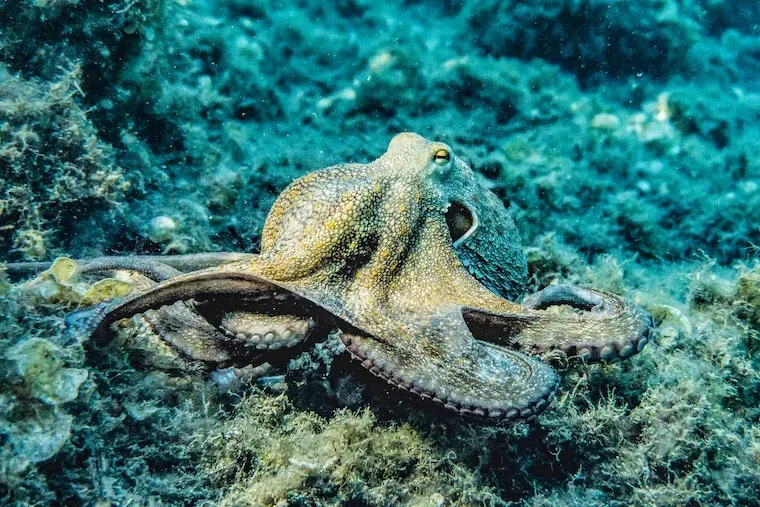
Octopuses can change both the color and texture of their skin in a fraction of a second to blend in with rocks, coral, or plants.
Octopuses have eight arms, not tentacles. Arms are lined with suckers along their entire length, while true tentacles (found on squid and cuttlefish) have suckers only near the tip.
Each of an octopus's arms contains its own cluster of neurons, letting the arms taste, sense, and react semi-independently of the brain.
Most octopuses are mildly venomous, but only the blue-ringed octopus is dangerous to humans; its venom can cause paralysis and, in rare cases, death.
If an octopus loses an arm, it can regenerate it over the course of a few months thanks to strong regenerative abilities.
Octopuses are largely solitary and mostly interact with others only to mate.
Octopuses live in every ocean on Earth, from shallow tide pools to the deep sea, and there are roughly 300 known species.
Octopuses have no internal or external skeleton, which lets them squeeze through any gap larger than their hard beak.
Most octopus species have short lives, typically living six months to five years depending on species; the giant Pacific octopus, one of the longest-lived, survives about 3 to 5 years.
Male octopuses transfer sperm to females using a specialized arm called a hectocotylus.
A female octopus lays thousands of eggs and guards them constantly, often without eating, until they hatch; some deep-sea octopuses have been observed brooding eggs for over four years.
Octopuses are known escape artists in captivity, able to open latched lids and squeeze through very small openings to get out of tanks.
The giant Pacific octopus is the largest octopus species, with arm spans that can reach around 16 feet (about 5 meters).
Frequently asked questions
How long do octopuses live?
Most octopuses live between six months and five years depending on the species. The giant Pacific octopus, one of the longer-lived species, typically survives about 3 to 5 years.
Can octopuses recognize humans?
Some studies suggest octopuses can distinguish between individual humans, along with different shapes and colors, though research on this is still limited.
Do octopuses have a skeleton?
No. Octopuses have no bones at all; their bodies are entirely soft tissue apart from a hard, parrot-like beak.
How do octopuses mate?
Male octopuses use a specialized arm called a hectocotylus to transfer a sperm packet to the female. She then lays and guards thousands of eggs until they hatch.
Can octopuses really escape from their tanks?
Yes. Octopuses are intelligent, curious, and boneless enough to squeeze through very small gaps, and there are many documented cases of them prying open lids and escaping aquarium tanks.
Why is octopus blood blue?
Octopus blood uses hemocyanin, a copper-based protein, to transport oxygen instead of the iron-based hemoglobin found in human blood, which gives it a blue color.
We write every article to be genuinely fun — and genuinely true. Each fact is checked against reputable sources before it goes live. Spotted something off? Tell us and read our fact-check policy.