FFacts On Tap Editorial Team Fact-checkedUpdated March 17, 20264 min read
Share
History isn't just names and dates - it's full of strange customs, record-breaking oddities, and stories stranger than fiction. From ancient Egyptian mourning rituals to the world's shortest war, these 25 facts have all been checked against reliable sources.
Read on for a tour through history's weirder corners, plus a few myths we set straight along the way.
In ancient Greece, athletes exercised and competed completely nude - the word "gymnasium" comes from the Greek "gymnos," meaning naked.
The Tarkhan Dress, unearthed in an Egyptian tomb and dated to roughly 5,000 years ago, is considered the world's oldest known woven garment.
Ancient Egyptians reportedly shaved off their eyebrows as a sign of mourning when a beloved pet cat died, according to the Greek historian Herodotus.
The earliest known printed use of "hello" as a greeting appeared in a Connecticut newspaper in 1826 - well before the telephone popularized it.
The shortest war in recorded history was the Anglo-Zanzibar War of 1896, which lasted only about 38 minutes before Zanzibar surrendered.
The oldest known joke on record is a Sumerian proverb roughly 3,900 years old, essentially a bathroom-humor one-liner about a young wife.
The first bristle toothbrush is credited to China around 1498, using hog bristles bound to a bamboo or bone handle.
The record for the longest wedding veil, set in Cyprus in 2018, measured over 22,000 feet - roughly the length of 63 football fields end to end, according to Guinness World Records.
The first computer mouse, built by Douglas Engelbart in 1964, was a wooden shell with a single button.
Cleopatra was not ethnically Egyptian - she descended from the Ptolemaic dynasty, a Greek Macedonian family that ruled Egypt after Alexander the Great.
The Great Wall of China is not actually visible to the naked eye from space, despite the popular myth - it's too narrow to be seen without aid at that distance.
The oldest surviving piano was built in Italy by Bartolomeo Cristofori in 1720 and is preserved today at the Metropolitan Museum of Art.
Dr. Seuss is widely credited with popularizing the word "nerd" in his 1950 book "If I Ran the Zoo."
During World War II, psychologist B.F. Skinner trained pigeons to help guide missiles as part of the classified "Project Pigeon" - though it was never actually deployed in combat.
Robert Wadlow, the tallest man ever reliably recorded, stood 8 feet 11 inches tall at the time of his death in 1940.
In imperial China, foot binding was practiced for centuries to keep women's feet small, a painful custom that persisted into the early 20th century.
In 1905, surgeons Alexis Carrel and Charles Guthrie successfully transplanted a dog's heart into another dog's neck, where it beat for roughly two hours - an early milestone toward human heart transplants, which didn't succeed until 1967.
Louis XIX of France holds the record for the shortest reign of any monarch, reigning for only about 20 minutes in 1830 before abdicating.
The first known published chocolate cake recipe appeared in an 1847 American cookbook by Eliza Leslie; earlier 18th-century "chocolate cakes" were actually solid blocks meant to be dissolved into a drink.
Ancient Romans used urine, a source of ammonia, as a cleaning agent for laundering clothes and even for teeth whitening.
One of the oldest known recipes in existence is a Sumerian hymn to the goddess Ninkasi describing how to brew beer, dating back roughly 3,800 years.
The largest snowflake ever reported measured 15 inches wide, according to an 1887 account from Fort Keogh, Montana - a claim Guinness World Records still lists, though it predates photography and can't be independently verified.
The first modern Olympic Games were held in Athens, Greece, in 1896.
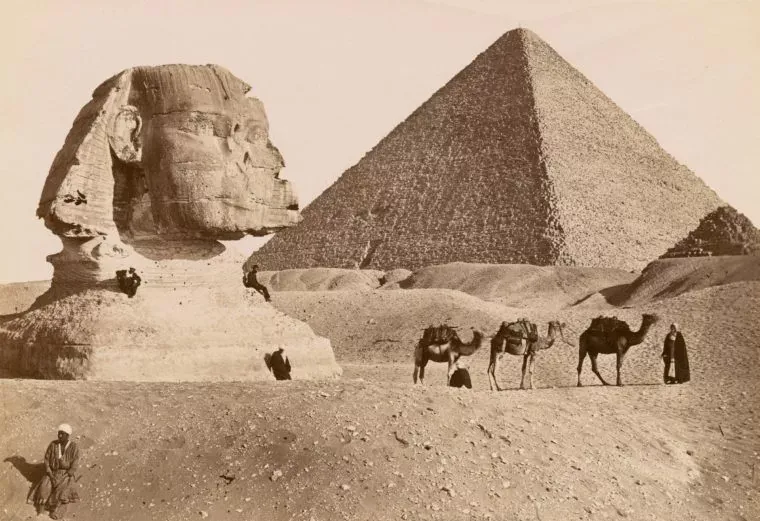
The Great Pyramid of Giza, built roughly 4,500 years ago, is the only one of the ancient Seven Wonders of the World still standing.
The Eiffel Tower was originally built as a temporary entrance arch for the 1889 World's Fair in Paris and was almost torn down 20 years later.
Frequently asked questions
Can I use these historical facts for school or research projects?
Yes, but always double-check specifics against primary or academic sources before citing them formally, since popular fact lists sometimes simplify or overstate the original research.
Is the Great Wall of China really visible from space?
No. The Great Wall is long but very narrow, and without magnification it cannot be distinguished from space with the naked eye - this is one of the most persistent myths about the structure.
What was the shortest war in history?
The Anglo-Zanzibar War of 1896 lasted only about 38 minutes, ending when Zanzibar's forces surrendered to the British Royal Navy.
Was Cleopatra Egyptian?
Not by ancestry. Cleopatra VII belonged to the Ptolemaic dynasty, descended from Ptolemy I, a Macedonian Greek general of Alexander the Great, though she ruled Egypt and, unusually for her family, learned the Egyptian language.
Did doctors really use pigeons to guide missiles in World War II?
Psychologist B.F. Skinner developed "Project Pigeon," training pigeons to peck at a target image to steer a missile. It worked in testing but was never deployed operationally.
How old is the oldest surviving piano?
The oldest known surviving piano was built in 1720 by Italian instrument maker Bartolomeo Cristofori and is now housed at the Metropolitan Museum of Art in New York.
We write every article to be genuinely fun — and genuinely true. Each fact is checked against reputable sources before it goes live. Spotted something off? Tell us and read our fact-check policy.