FFacts On Tap Editorial Team Fact-checkedUpdated February 8, 20264 min read
Share
The contributions of Black inventors have often gone unrecognized, yet their impact on daily life has been enormous. From the electric light bulb to the traffic signal to cataract surgery, their work has quietly shaped how we travel, communicate, and heal.
Here are ten Black inventors whose ideas changed history, along with the facts behind their real achievements.
Lewis Howard Latimer (1848-1928) was born in Chelsea, Massachusetts, to parents who had escaped slavery. In 1876 he drafted the precise patent drawings that helped Alexander Graham Bell secure the telephone patent.
In the 1880s, Latimer patented an improved method for manufacturing durable carbon filaments for electric light bulbs, helping make incandescent lighting more practical and affordable.
Granville T. Woods (1856-1910) was born in Columbus, Ohio, and held more than 50 patents over his lifetime, many in railway and telegraph technology.
Woods was nicknamed the \"Black Edison\" and invented the multiplex telegraph, which let messages be sent between moving trains and stations to help prevent collisions.
Elijah McCoy (1844-1929) was born in Colchester, Ontario, Canada, the son of parents who had escaped slavery in the U.S. via the Underground Railroad.
McCoy patented an automatic lubricator that fed oil to moving train engine parts without stopping the machine, saving time and reducing wear; he held roughly 50 patents in all.
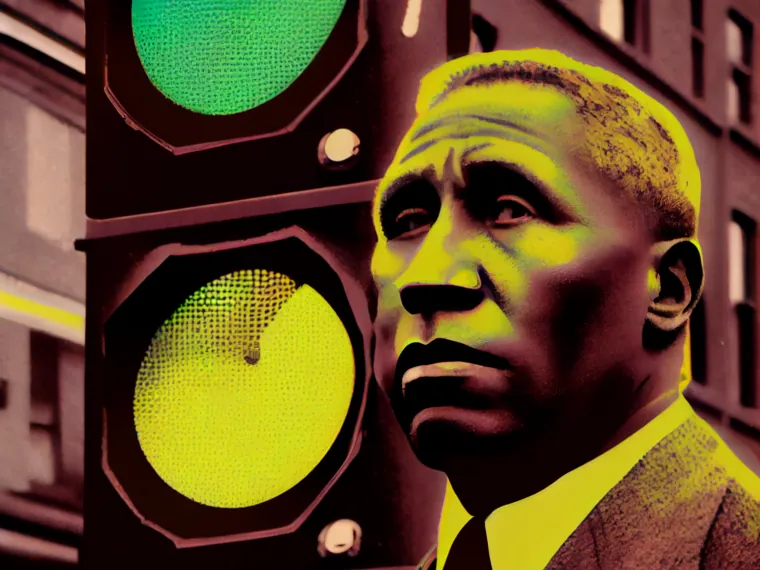
Garrett Augustus Morgan (1877-1963) was born in Paris, Kentucky, the son of formerly enslaved parents. He patented an early gas mask in 1914 and a three-position traffic signal in 1923.
Morgan's traffic signal patent was later purchased by General Electric, and his safety hood design is considered a forerunner of the modern gas mask used by firefighters and soldiers.
Sarah Boone (1832-1904), born Sarah Marshall in North Carolina, patented an improved ironing board in 1892 with a narrow, curved design suited for pressing sleeves and fitted garments.
Jan Ernst Matzeliger (1852-1889) was born in Paramaribo, Suriname, the son of a Dutch engineer father and a Surinamese mother, and immigrated to the United States as a young man.
In 1883, Matzeliger patented a shoe-lasting machine that automated attaching a shoe's upper to its sole, cutting production time and cost and transforming the shoe industry.
Madam C.J. Walker, born Sarah Breedlove in Delta, Louisiana in 1867, built a hair care and cosmetics business for Black women and became one of the first American women to build a self-made fortune.
Walker was also a major philanthropist, funding scholarships, YMCAs, and anti-lynching efforts through the NAACP.
Benjamin Banneker (1731-1806) was a self-taught mathematician and astronomer from Maryland who built a working wooden clock and published almanacs predicting eclipses.
In 1791, Banneker assisted surveyor Andrew Ellicott with astronomical observations used to fix the starting boundary point for the new federal capital, Washington, D.C. He did not design the city's street plan; that claim is a popular myth.
Dr. Patricia Bath (1942-2019), born in New York City, became the first African American woman to complete a residency in ophthalmology.
In 1988 Bath patented the Laserphaco Probe, a laser device for removing cataracts more precisely, and later became the first Black female physician to receive a U.S. patent for a medical device.
George Washington Carver (circa 1864-1943) was born into slavery in Diamond, Missouri, and became a leading agricultural scientist and educator at Tuskegee Institute.
Carver developed hundreds of uses for peanuts, sweet potatoes, and soybeans, and promoted crop rotation to restore nutrients to cotton-depleted Southern soil.
Otis Boykin (1920-1982), born in Dallas, Texas, invented an improved wire resistor that made electronic components cheaper and more reliable, later used in guided missiles, computers, and pacemakers.
Marie Van Brittan Brown, a Black nurse from Queens, New York, co-patented the first home security system with a video camera and remote monitoring in 1969, laying groundwork for modern CCTV systems.
Frequently asked questions
Who was the first African American woman to complete a residency in ophthalmology?
Dr. Patricia Bath was the first African American woman to complete a residency in ophthalmology, and she later invented the Laserphaco Probe for cataract surgery.
Who was known as the 'Black Edison'?
Granville T. Woods was known as the 'Black Edison' for his more than 50 patents in electrical and railway technology, including the multiplex telegraph.
Did Benjamin Banneker design the layout of Washington, D.C.?
No. Banneker assisted surveyor Andrew Ellicott with astronomical measurements to establish the capital's boundary in 1791. The popular claim that he redrew Pierre L'Enfant's city plan from memory after L'Enfant left the project is a myth; Banneker had already left the survey before L'Enfant was dismissed.
What did Lewis Latimer invent?
Latimer drafted the patent drawings that helped Alexander Graham Bell secure the telephone patent in 1876, and he later patented an improved, longer-lasting carbon filament for electric light bulbs.
Who invented the traffic signal used by Garrett Morgan?
Garrett Morgan patented a three-position traffic signal in 1923; General Electric later purchased the rights to his design.
How many patents did Elijah McCoy hold?
Elijah McCoy held roughly 50 patents during his lifetime, most related to lubrication systems for steam engines and other machinery.
We write every article to be genuinely fun — and genuinely true. Each fact is checked against reputable sources before it goes live. Spotted something off? Tell us and read our fact-check policy.