FFacts On Tap Editorial Team Fact-checkedUpdated July 13, 20233 min read
Share
Lizards are among the most successful reptiles on Earth, thriving on every continent except Antarctica in forms ranging from finger-sized geckos to the massive Komodo dragon. With over 6,000 species, they've evolved a wild toolkit of survival tricks, from color-changing skin to tails that detach and grow back.
Here are 22 fact-checked facts about lizards, plus answers to the questions people ask most.
Lizards are reptiles belonging to the order Squamata, which they share with snakes.
There are more than 6,000 known species of lizards, found on every continent except Antarctica.
One of the smallest lizards, the Virgin Islands dwarf gecko, is barely bigger than a US dime; an even tinier relative, the Jaragua sphaero of the Dominican Republic, is considered the world's smallest known reptile.
The largest lizard is the Komodo dragon, which can grow up to about 10 feet (3 meters) long.
Lizards have dry, scaly skin made of keratin that helps protect them and reduce water loss.
Most lizards are carnivorous or insectivorous, eating insects, spiders, and other small animals, though some species are herbivorous or omnivorous.
Many lizards, such as chameleons and anoles, can change color to regulate temperature, communicate, or blend into their surroundings.
Many lizards can voluntarily detach their tails, a defense called autotomy, to escape predators.
The basilisk lizard can run across the surface of water on its hind legs, earning it the nickname 'Jesus lizard.'
A few lizards are venomous, including the Gila monster and the Mexican beaded lizard.
Lizards have good hearing for detecting predators and prey, though their sensitivity generally overlaps with the human hearing range rather than exceeding it.
Chameleons have long, sticky, projectile tongues that can shoot out to catch prey in a fraction of a second.
Many lizards have a light-sensitive 'parietal eye' or 'third eye' on top of their head that helps them detect changes in light and regulate circadian rhythms.
Many lizards can regrow a lost tail, though the replacement is usually a cartilage-supported stub rather than an exact copy of the original.
Green anoles can change their overall body color between green and brown, and the skin around their eyes can also shift color as part of that same response.
Lizards are cold-blooded (ectothermic) and rely on their environment, such as sunny rocks, to regulate their body temperature.
Lizards breathe primarily through their lungs; unlike amphibians, they do not rely on their skin for meaningful gas exchange.
The frilled lizard can rear up and sprint on its hind legs to escape danger, sometimes flaring the neck frill it's named for.
Many lizards have a strong sense of smell, using their tongue and a specialized Jacobson's (vomeronasal) organ to detect chemical cues and locate food.
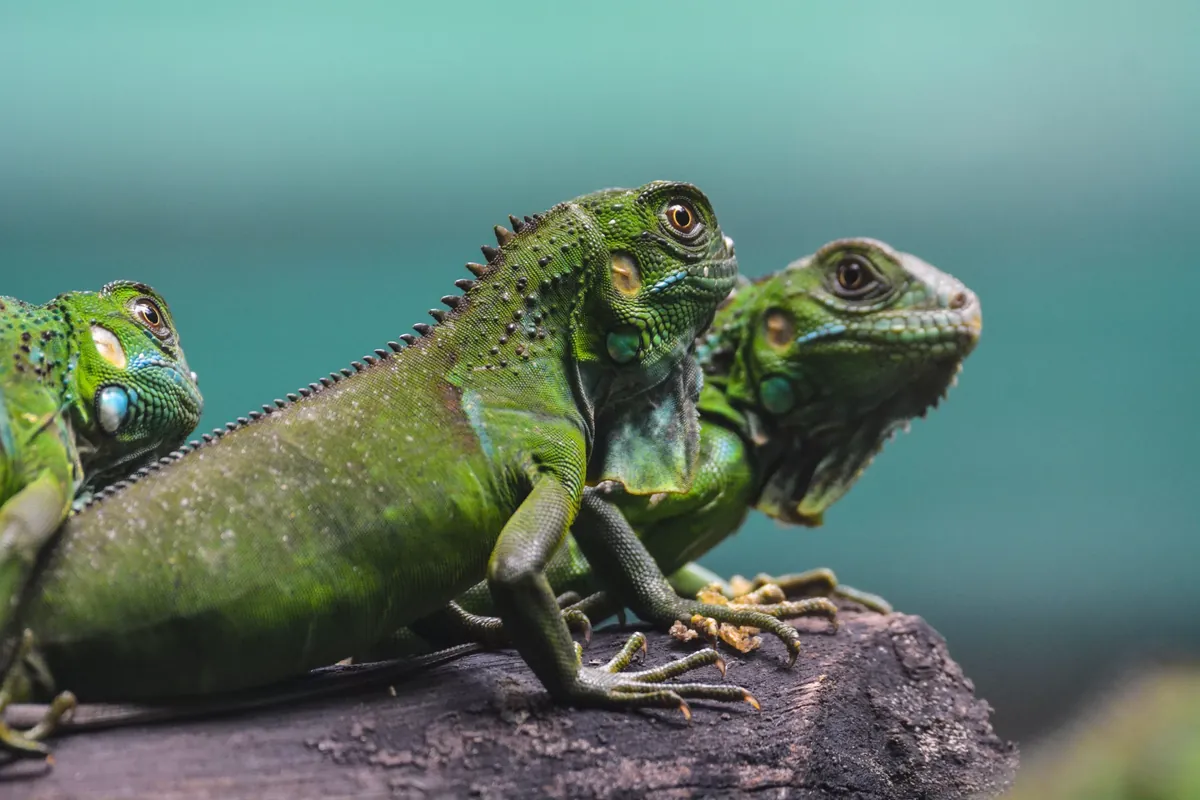
Green iguanas can live up to 15-20 years in the wild with good conditions, and often longer in captivity.
Lizards help control insect and pest populations, making them an important part of many ecosystems.
Horned lizards can squirt a stream of blood from their eyes as a startling defense against predators such as coyotes and foxes.
Geckos are unusual among lizards for lacking eyelids; instead, many species lick their own eyes clean with their tongues.
Frequently asked questions
How do lizards reproduce?
Most lizards lay eggs, but a number of species, including many skinks and some geckos, give birth to live young.
What is the difference between a lizard and a gecko?
Geckos are a specific family of lizards, many of which have sticky toe pads that let them climb smooth surfaces like walls and ceilings.
Are all lizards carnivorous?
No. While most lizards eat insects or other small animals, some species, such as iguanas, are largely herbivorous.
What is the lifespan of a lizard?
It varies widely by species, but many common pet and wild lizards live somewhere between 5 and 20 years.
Can lizards make good pets?
Yes, species like bearded dragons and leopard geckos are popular pets and can thrive with proper care, housing, and diet.
Are lizards dangerous to humans?
Most lizards are harmless to people, but a few venomous species, like the Gila monster, can deliver a painful and medically significant bite if provoked.
We write every article to be genuinely fun — and genuinely true. Each fact is checked against reputable sources before it goes live. Spotted something off? Tell us and read our fact-check policy.