FFacts On Tap Editorial Team Fact-checkedUpdated July 29, 20233 min read
Share
Butterflies are some of the most fascinating creatures on the planet, known for their bright colors, delicate wings, and gentle fluttering flight. Found on every continent except Antarctica, these insects play a surprisingly important role in ecosystems around the world.
Below are verified, fact-checked facts about butterflies, their life cycle, behavior, and biology.
Scientists have described roughly 17,500 to 20,000 butterfly species worldwide, though new species are still being identified.
Common and widespread butterfly groups include swallowtails, monarchs, and painted ladies.
Butterflies live on every continent except Antarctica.
Butterfly wings are covered in thousands of tiny overlapping scales, which is why the insects belong to the order Lepidoptera, meaning 'scale wing' in Greek.
The colors on a butterfly's wings come from a mix of pigments in the scales and microscopic structures that reflect and scatter light, producing iridescent effects in some species.
Butterflies taste with their feet. Chemoreceptors on their legs let them sample a plant's chemistry to check whether it's a suitable place to lay eggs.
A group of butterflies is sometimes called a 'kaleidoscope,' inspired by the shifting colors and patterns of their wings.
Butterflies undergo complete metamorphosis through four life stages: egg, larva (caterpillar), pupa (chrysalis), and adult.
Most adult butterflies live only a few weeks, though some species, like the mourning cloak, can survive nearly a year including overwintering as adults.
Butterflies are important pollinators, helping transfer pollen between flowers as they feed on nectar.
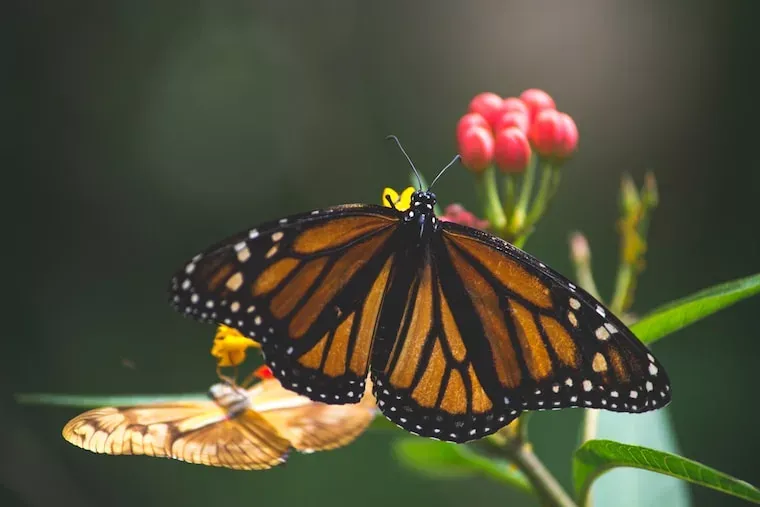
Monarch butterflies undertake one of the longest known insect migrations, traveling as much as 3,000 miles between North America and their overwintering sites in central Mexico.
No single monarch completes the full round-trip migration; it typically takes three to four generations to finish the journey each year.
Because caterpillars transform into butterflies, the insects are widely used as symbols of change and transformation.
Butterflies are cold-blooded and often bask with wings spread to absorb heat from the sun before they can fly.
Some butterfly species, such as the viceroy, use mimicry to resemble toxic species like the monarch, discouraging predators from eating them.
A butterfly's proboscis is a long, coiled, straw-like tube it uses to sip nectar, and it stays curled up when not feeding.
Butterflies see a wider range of colors than humans, including ultraviolet light, which helps them locate flowers and potential mates.
Frequently asked questions
How do butterflies survive the winter?
It depends on the species. Monarch butterflies migrate to warmer climates such as central Mexico or coastal California, while species like the mourning cloak overwinter as adults, hibernating in tree bark or leaf litter until spring.
How do butterflies communicate with each other?
Butterflies rely mainly on visual cues, like wing color and pattern, to attract mates or signal warnings, and many species also release pheromones, chemical scent signals, to communicate with others of their kind.
Do butterflies have predators?
Yes. Birds, spiders, wasps, and other insects all prey on butterflies at various life stages. Many species have evolved camouflage or mimicry, such as resembling a more toxic species, to help avoid being eaten.
How can I attract butterflies to my garden?
Plant nectar-rich flowers for adult butterflies along with host plants, like milkweed for monarchs, that caterpillars can feed on. Coneflower and butterfly bush are also popular nectar sources.
Why are butterflies important?
Butterflies are valuable pollinators that help many flowering plants reproduce, and because they're sensitive to changes in habitat and climate, their populations serve as an indicator of overall ecosystem health.
We write every article to be genuinely fun — and genuinely true. Each fact is checked against reputable sources before it goes live. Spotted something off? Tell us and read our fact-check policy.