The Fascinating History of the First Computer Mouse
FFacts On Tap Editorial Team Fact-checkedUpdated December 3, 20253 min read
Share
The mouse sitting under your hand today looks nothing like the very first one. Before there were scroll wheels, wireless signals, or even a second button, there was a hand-carved wooden box with a single button and two metal wheels underneath.
That odd little device, built in the 1960s, kicked off one of the most quietly revolutionary inventions in computing history. Here's the real story of where it came from.
The computer mouse was invented by Douglas Engelbart, a researcher at the Stanford Research Institute (SRI, now SRI International) in Menlo Park, California.
Engelbart began developing the idea in the early 1960s as part of a larger project he started in 1962 aimed at using computers to 'augment human intellect.'
The first mouse prototype was a hand-carved wooden shell with a single button and two perpendicular metal wheels inside that tracked movement along the X and Y axes.
Engelbart's formal name for the device was the 'X-Y Position Indicator for a Display System.'
The device was nicknamed the 'mouse' because its cord trailed out the back like a tail, and the name stuck.
Bill English, an engineer at SRI, built the first working mouse prototype from Engelbart's design.
Engelbart publicly unveiled the mouse on December 9, 1968, during a 90-minute presentation at the Fall Joint Computer Conference in San Francisco, an event later nicknamed 'The Mother of All Demos.'
That same 1968 demo also introduced hypertext, video conferencing, and collaborative real-time editing, ideas that were decades ahead of their time.
Engelbart and SRI were granted U.S. Patent No. 3,541,541 for the 'X-Y Position Indicator for a Display System' on November 17, 1970.
The patent application had actually been filed years earlier, in 1967, before the public demo took place.
Engelbart never earned significant royalties from the mouse patent; SRI licensed the technology to Apple in the 1980s for a flat fee.
One of the first commercial computers designed to work with a mouse was the Xerox Alto, developed at Xerox PARC in 1973.
Apple popularized the mouse for home users with the Apple Lisa in 1983 and the Macintosh in 1984, both of which used a single-button design inspired by earlier research.
Early mice used mechanical wheels or a rolling ball to track movement; modern mice typically use an optical or laser sensor instead.
Wireless mice, which use radio or Bluetooth signals instead of a cord, became widely available in the late 1990s and 2000s.
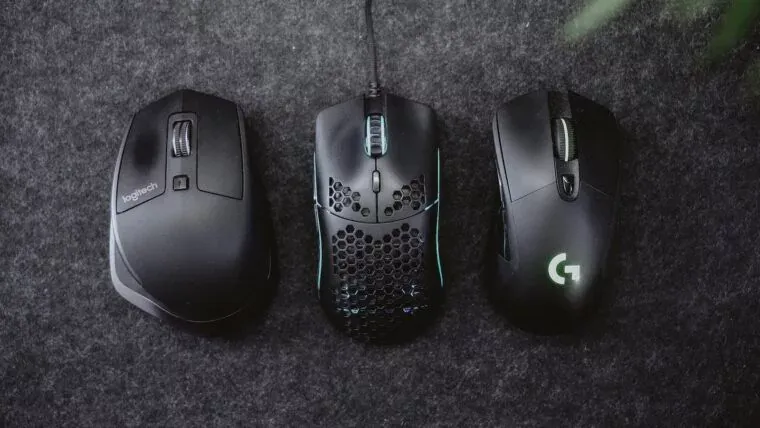
Today's mice come in many specialized forms, including ergonomic mice designed to reduce wrist strain and gaming mice with programmable buttons and high-precision sensors.
The original wooden prototype mouse still exists and has been preserved and exhibited by institutions including the Smithsonian.
Engelbart received the National Medal of Technology in 2000 and was inducted into the National Inventors Hall of Fame for his work on human-computer interaction.
Frequently asked questions
What was the first computer mouse made of?
The first computer mouse prototype was a hand-carved wooden shell housing two perpendicular metal wheels that tracked movement, with a single button on top.
Who invented the computer mouse?
Douglas Engelbart conceived the mouse at the Stanford Research Institute, and engineer Bill English built the first working prototype from Engelbart's design.
When was the first public demonstration of the computer mouse?
Engelbart demonstrated the mouse publicly on December 9, 1968, at the Fall Joint Computer Conference in San Francisco, an event now known as 'The Mother of All Demos.'
When was the computer mouse patented?
The patent for the 'X-Y Position Indicator for a Display System' was granted on November 17, 1970, though it had been filed in 1967.
How has the computer mouse evolved over time?
It went from a wooden, single-button, wired device with tracking wheels to today's multi-button, scroll-wheel, wireless mice that use optical or laser sensors instead of mechanical parts.
Where is the original computer mouse now?
The original wooden prototype has been preserved and displayed by institutions including the Smithsonian.
We write every article to be genuinely fun — and genuinely true. Each fact is checked against reputable sources before it goes live. Spotted something off? Tell us and read our fact-check policy.