FFacts On Tap Editorial Team Fact-checkedUpdated June 17, 20233 min read
Share
Cardinals are some of the most beloved backyard birds in North America, instantly recognizable for their vivid red plumage and cheerful whistling songs. Beyond their striking looks, cardinals have surprisingly rich behaviors, from lifelong pair bonds to fierce territorial defense.
Here are the most interesting, verified facts about cardinals, along with answers to common questions about these popular songbirds.
Cardinals are songbirds that belong to the family Cardinalidae.
The Northern Cardinal is found across eastern, central, and parts of southwestern North America, from southern Canada through the eastern and central United States down to Mexico and northern Central America; it does not naturally occur in South America, though other, unrelated bird species there are also called cardinals.
The Northern Cardinal is the official state bird of seven U.S. states: Illinois, Indiana, Kentucky, North Carolina, Ohio, Virginia, and West Virginia.
Cardinals are largely monogamous and often keep the same mate for several breeding seasons, forming strong pair bonds.
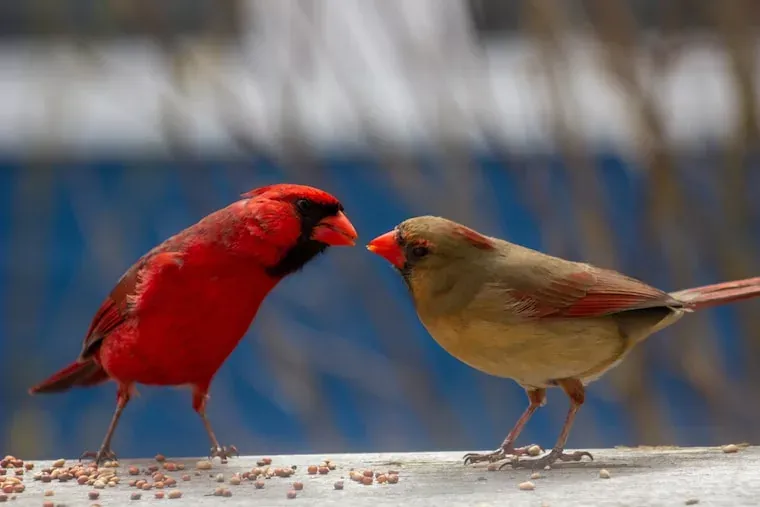
The male Northern Cardinal is a bright red color, while the female is a more muted brownish-red with reddish tinges on her wings, tail, and crest.
They are territorial birds and will fiercely defend their nesting and feeding areas, especially during breeding season.
Cardinals are omnivores and eat a variety of seeds, fruits, insects, and other small invertebrates.
They have a powerful, thick, cone-shaped beak that is well-suited for cracking open seeds and nuts.
Cardinals are known for their loud, clear whistling songs, and unlike many songbirds, both males and females sing.
The female cardinal is the primary nest builder and constructs a cup-shaped nest out of twigs, grasses, and other plant materials.
Northern Cardinals are non-migratory and stay in their territories year-round, even through cold winters.
The Northern Cardinal is named after the red robes and caps worn by Roman Catholic cardinals.
Most Northern Cardinals live 3 to 5 years in the wild, though the oldest banded wild cardinal on record lived to be at least 15 years and 9 months old.
They are a popular bird among backyard birdwatchers and are frequently attracted to feeders stocked with sunflower seeds.
Cardinals are adaptable birds that thrive in a variety of habitats, including woodlands, thickets, gardens, and suburban yards.
Cardinals have a distinctive crest on their head that they can raise or lower depending on their mood.
The male cardinal's red plumage comes from carotenoid pigments obtained through its diet, particularly from fruits and insects.
Like many wild birds, cardinals can be affected by diseases such as avian pox and West Nile virus.
In some Native American traditions, the cardinal is seen as a symbol of love, loyalty, and devotion.
A group of cardinals is sometimes called a "college" or a "conclave," playful nods to the bird's churchly namesake.
Frequently asked questions
What is the difference between male and female cardinals?
Male cardinals are bright red with a black mask around the eyes and bill, while females are a more muted brownish-red with reddish tinges on their wings, crest, and tail.
What do cardinals eat?
Cardinals are omnivores that eat a mix of seeds, fruits, and insects, and they're especially fond of sunflower seeds at backyard feeders.
Do cardinals migrate?
No, Northern Cardinals are non-migratory and remain in their territories year-round, even through winter.
How do cardinals mate?
Cardinals are largely monogamous and often pair with the same mate across multiple breeding seasons, forming strong, lasting bonds.
Where do cardinals build their nests?
Female cardinals build the nest, typically a cup shape woven from twigs, grasses, and bark strips, usually hidden in dense shrubs or low tree branches.
What is the lifespan of a cardinal?
Most wild cardinals live 3 to 5 years, though the oldest banded wild cardinal on record reached at least 15 years and 9 months.
We write every article to be genuinely fun — and genuinely true. Each fact is checked against reputable sources before it goes live. Spotted something off? Tell us and read our fact-check policy.