FFacts On Tap Editorial Team Fact-checkedUpdated February 20, 20264 min read
Share
Jellyfish drift through every ocean on Earth, pulsing along on nothing but water and nerve. They have no brain, no bones, and no blood, yet they've outlasted dinosaurs, mastered a bizarre form of biological rejuvenation, and produced one of the most potent venoms in the animal kingdom.
Here are the facts about jellyfish worth knowing, verified against marine biology sources and corrected where the popular version gets it wrong.
Jellyfish aren't fish at all - they're invertebrates with no backbone, more closely related to corals and sea anemones.
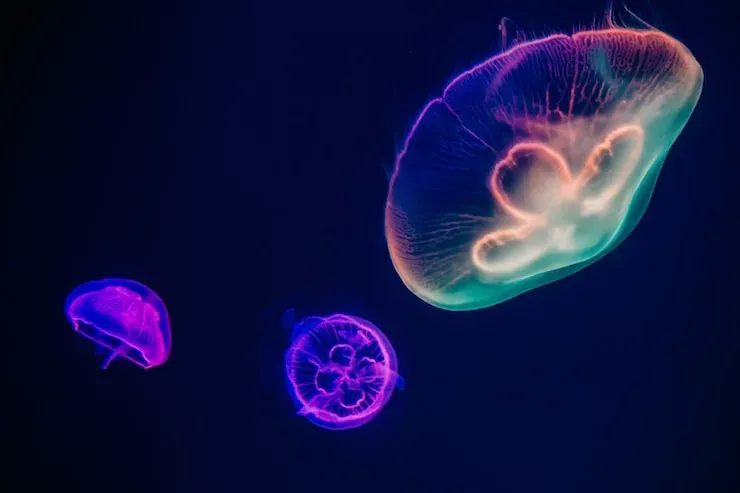
There are more than 2,000 known species of jellyfish, and the moon jellyfish is one of the most common and widespread.
Jellyfish have been around for at least 500 million years, with fossil impressions dating to the Cambrian period, making them older than dinosaurs and even most fish.
A jellyfish's body is roughly 95% water, which is why it's so lightweight and nearly transparent.
Some jellyfish are bioluminescent, producing their own light to startle predators or lure prey.
Jellyfish are slow, drifting swimmers; most species move at only about 1-2 miles per hour and rely heavily on ocean currents to get around.
Jellyfish have no brain and no centralized nervous system - instead, they sense their surroundings through a simple, diffuse net of nerves spread through the body.
Jellyfish are carnivores that feed on plankton, small fish, fish eggs, and sometimes other jellyfish.
Most jellyfish live for only a few months, though a handful of species can survive a year or more.
Jellyfish aren't considered endangered as a group; in fact, some regions have seen jellyfish blooms increase, likely linked to overfishing of their predators and competitors, warming waters, and nutrient pollution.
Jellyfish are an important part of the marine food web, eaten by sea turtles, ocean sunfish, and various seabirds.
Jellyfish can reproduce both sexually and asexually: adults release sperm and eggs into the water, while earlier polyp stages can clone themselves repeatedly.
Jellyfish stings range from a mild itch to severe, and in rare cases, life-threatening reactions in humans depending on the species.
Peeing on a jellyfish sting is a myth and can make things worse - rinsing with vinegar (for box jellyfish stings) or hot water is the treatment recommended by health authorities.
The immortal jellyfish (Turritopsis dohrnii) can revert its adult cells back into an earlier juvenile polyp stage through a process called transdifferentiation, effectively restarting its life cycle - a trait that has earned it the label 'biologically immortal.'
The box jellyfish (Chironex fleckeri) is widely considered the most dangerous jellyfish to humans; its venom can trigger cardiac arrest and has caused death in as little as a few minutes.
The lion's mane jellyfish is the largest known jellyfish species. The largest recorded specimen had a bell nearly 8 feet across with tentacles stretching more than 120 feet - long enough to rival a blue whale.
Jellyfish don't have true eyes, but many species have light-sensitive structures called ocelli, and box jellyfish have more complex eyes with lenses that can form images.
Some small fish, like juvenile banded stingfish or those living with the purple-striped jelly, shelter among jellyfish tentacles for protection from predators, showing a degree of tolerance to the jellyfish's sting.
Jellyfish move through a form of jet propulsion, contracting and relaxing their bell-shaped bodies to push water out and propel themselves forward.
Jellyfish tentacles are lined with microscopic stinging cells called nematocysts, which fire venom-coated barbs on contact - and can still sting even after the jellyfish is dead or washed ashore.
Frequently asked questions
What should I do if I get stung by a jellyfish?
Rinse the area with vinegar (especially for box jellyfish stings) or hot water, remove any visible tentacles with tweezers or a card's edge, and avoid fresh water or rubbing the area, which can trigger more stinging cells to fire. Seek medical help for severe reactions or stings from known dangerous species.
Can jellyfish swim upside down?
Yes. Some species, like the upside-down jellyfish (Cassiopea), spend most of their time resting bell-down on the seafloor, using their tentacles to filter feed and host photosynthetic algae.
Are jellyfish dangerous to humans?
Most species deliver only a mild sting, but a few, like the box jellyfish, have venom potent enough to be life-threatening. It's best to avoid touching any jellyfish, including ones washed up on the beach.
How do jellyfish reproduce?
Adult jellyfish typically reproduce sexually, with males releasing sperm to fertilize eggs released by females; the resulting larvae settle and grow into polyps, which can then clone themselves asexually before budding off new jellyfish.
Can jellyfish survive out of water?
Most jellyfish cannot survive long out of water since their bodies rely on it for structure and gas exchange, though some can hold on for short periods if kept moist and cool.
Is the immortal jellyfish truly impossible to kill?
No - 'biologically immortal' means it can potentially avoid dying of old age by resetting its life cycle, but it can still be killed by predators, disease, or environmental harm.
We write every article to be genuinely fun — and genuinely true. Each fact is checked against reputable sources before it goes live. Spotted something off? Tell us and read our fact-check policy.