FFacts On Tap Editorial Team Fact-checkedUpdated February 22, 20264 min read
Share
Every year, huge stretches of the Amazon rainforest vanish beneath rising floodwaters, turning treetops into fish habitat and forest floors into riverbed. These flooded forests, and the eerie standing-dead forests created by modern dams, are among the most unusual ecosystems on Earth.
Here's what's actually known about how they form, who lives in them, and why they matter.
Each year, seasonal floods submerge vast areas of the Amazon rainforest for months at a time, a cycle known as the flood pulse.
These seasonally flooded forests come in two main types: varzea, flooded by nutrient-rich "whitewater" rivers carrying Andean sediment, and igapo, flooded by nutrient-poor "blackwater" or clearwater rivers.
In parts of the Amazon, floodwaters can rise more than 30-40 feet, submerging trees up to their canopies for much of the year.
Fish such as the tambaqui and the arapaima swim directly into the flooded forest to feed on fallen fruit and seeds from the trees.
The tambaqui has powerful, nut-cracking jaws adapted to crush hard fruit and seed pods that fall into the water.
The arapaima, or pirarucu, is one of the largest freshwater fish in the world and can grow beyond 6 feet in length.
By eating fruit and later excreting the seeds elsewhere, fish in the flooded forest act as seed dispersers, a role usually played by birds and monkeys in dry forest.
A single tambaqui can carry and disperse intact seeds from dozens of different plant species across long distances as it swims between flooded areas.
Roughly half to 90% of Amazonian tree species rely on animals, including fish, to disperse their seeds.
Flooded forests also support a rich web of algae, invertebrates, and microorganisms that form the base of the aquatic food chain.
Not all of the Amazon's underwater forests are seasonal. Brazil's Balbina Dam, completed in 1989, permanently flooded roughly 2,360 square kilometers of rainforest to create its reservoir.
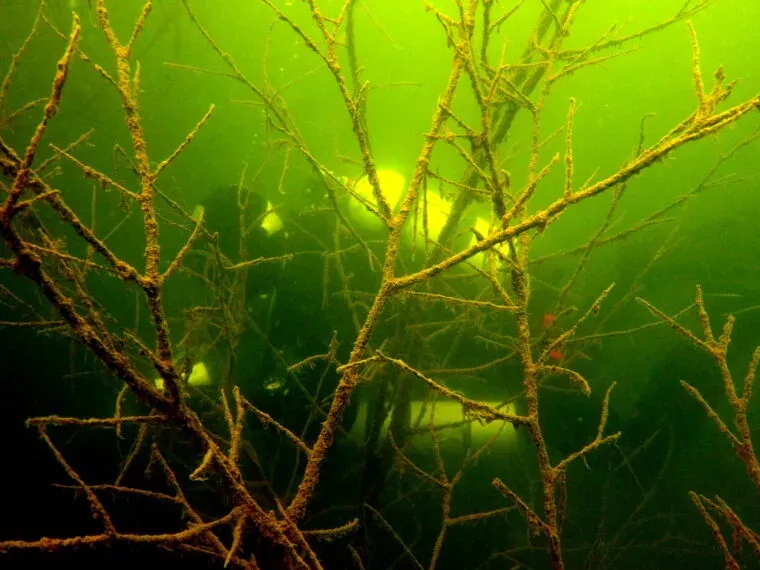
Because the forest was not cleared before flooding, the skeletons of dead trees still stand throughout the shallow, ship-hazarding waters of the Balbina reservoir.
The Balbina reservoir contains around 1,500 forested islands, remnants of hilltops that stayed above the rising water.
Decomposing submerged vegetation in reservoirs like Balbina's produces acidic, low-oxygen water and releases methane, a potent greenhouse gas.
Changes to the natural flood cycle below Balbina Dam have killed floodplain trees for roughly 100 kilometers downstream, since those trees are adapted to a very specific pattern of seasonal flooding.
Healthy, naturally flooded forests act as important carbon sinks, and disrupting their flood cycles can undermine that role rather than enhance it.
Flooded forests serve as nurseries for many commercially and ecologically important Amazon fish species.
Frequently asked questions
What causes the Amazon's underwater forests to form?
Most form through the Amazon's natural seasonal flood pulse, in which rising rivers submerge floodplain forests (varzea and igapo) for months at a time. Some, like the forest in Brazil's Balbina Dam reservoir, were created artificially when a dam permanently flooded unlogged rainforest.
What animals live in the Amazon's flooded forests?
Large fruit-eating fish such as the tambaqui and arapaima are among the most notable residents, along with countless invertebrates, algae, and microorganisms that support the wider aquatic food web.
Do fish really eat fruit from trees in these forests?
Yes. When the forest floods, fish like the tambaqui swim among the trees to eat fallen fruit and seeds, later dispersing the undigested seeds elsewhere, a role that land animals play during the dry season.
Is the underwater forest at the Balbina Dam a natural phenomenon?
No. It resulted from the 1989 construction of the Balbina hydroelectric dam, which flooded about 2,360 square kilometers of rainforest that was never logged, leaving dead trees still standing in the reservoir today.
Why are the Amazon's flooded forests important?
They provide critical nursery habitat for many fish species and, when their natural flood cycles remain intact, help store carbon. Disrupting those cycles, as has happened downstream of some dams, can instead kill trees and release stored carbon and methane.
Is petrified wood forming in the Amazon's underwater forests today?
No credible evidence supports this. Petrification (permineralization) is a geological process that typically takes thousands to millions of years under specific burial conditions, not something documented as actively occurring in modern seasonally flooded Amazon forests.
We write every article to be genuinely fun — and genuinely true. Each fact is checked against reputable sources before it goes live. Spotted something off? Tell us and read our fact-check policy.