How Bioluminescence Lights Up the World: The Science Behind Nature's Glow
FFacts On Tap Editorial Team Fact-checkedUpdated November 14, 20254 min read
Share
Bioluminescence is one of nature's most mesmerizing tricks: the ability of living things to produce their own light through a chemical reaction happening right inside their cells. It shows up across an astonishing range of life, from glowing bacteria and fungi to fireflies, jellyfish, and deep-sea fish.
So how does a living creature make light without heat or electricity, and why did this ability evolve in the first place? Here's what's actually going on, and where you can witness it for yourself.
Bioluminescence is light produced by a chemical reaction inside a living organism, rather than light that is absorbed or reflected from another source.
The reaction requires two key ingredients: luciferin, a light-emitting compound, and luciferase, an enzyme that helps oxidize the luciferin and release energy as light.
Because the reaction is a chemical one and not a heating process, bioluminescence is often called 'cold light' — it releases very little heat compared to a light bulb or flame.
The exact color of the glow depends on the specific luciferin-luciferase pair involved, along with factors like pH, temperature, and oxygen availability.
Many organisms can control their glow, switching it on and off or adjusting its intensity by regulating the luciferin and luciferase in their cells.
Fireflies (which are actually beetles, not flies) use flashing light patterns to signal their species and sex to potential mates.
The deep-sea anglerfish's glowing lure isn't produced by the fish's own cells — it comes from colonies of bioluminescent bacteria (often in the genus Photobacterium) that live symbiotically inside the lure.
Some deep-sea squid, such as species in the genus Heteroteuthis, eject a glowing cloud of bioluminescent mucus or 'ink' to startle and distract predators, buying time to escape.
Certain deep-sea fish carry light-producing organs called photophores near their eyes or along their bodies, which can help them spot prey, communicate, or camouflage against light filtering down from above.
New Zealand's glowworm caves are home to the larvae of a fungus gnat called Arachnocampa luminosa, which glow blue-green from a light organ near the rear of their bodies.
Glowworm larvae use their light to lure small flying insects into sticky silk threads they've spun, then reel in and eat the trapped prey.
Research published in Scientific Reports found that New Zealand glowworms use a luciferase similar to a firefly's, but an entirely different, previously unknown luciferin molecule.
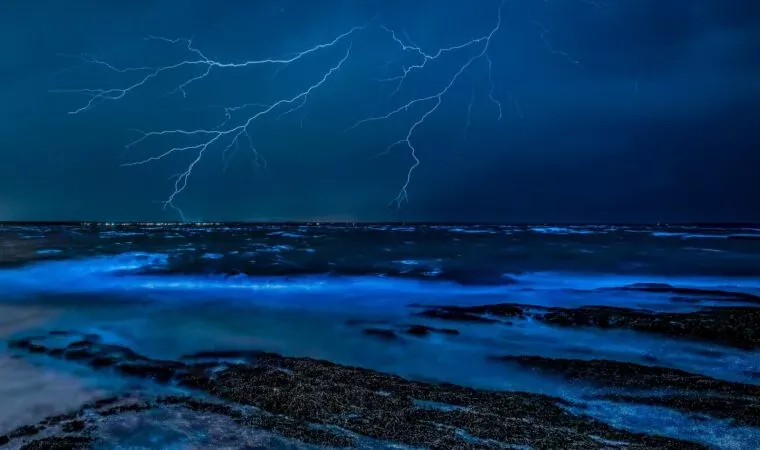
Ocean sparkle seen at night in some coastal waters is often caused by bioluminescent dinoflagellates, single-celled plankton that flash blue-green light when the water is disturbed by waves, boats, or swimmers.
Scientists believe this plankton 'flash' may work as a defense mechanism, sometimes called a burglar alarm, that can startle small predators or attract larger predators to attack whatever is disturbing the plankton.
Some of the most famous synchronized firefly displays occur in the Great Smoky Mountains in the United States and in parts of Southeast Asia, where fireflies flash in unison during mating season.
Puerto Rico is home to several of the world's brightest bioluminescent bays, including Mosquito Bay in Vieques, where dense populations of the dinoflagellate Pyrodinium bahamense glow when the water is agitated.
Bioluminescence is estimated to have evolved independently more than 40 separate times across the tree of life, a striking example of convergent evolution.
In the ocean, bioluminescence is especially common at depth: some estimates suggest the majority of animals living below about 3,280 feet (1,000 meters) are capable of producing their own light.
Frequently asked questions
What is bioluminescence?
Bioluminescence is the ability of a living organism to produce its own light through a chemical reaction happening inside its cells, rather than reflecting or absorbing light from an outside source.
How does bioluminescence work?
It's driven by a reaction between a light-emitting molecule called luciferin and an enzyme called luciferase, which helps oxidize the luciferin and release energy in the form of light.
Why do organisms produce bioluminescence?
Reasons vary by species and include attracting mates, luring or confusing prey and predators, startling attackers, and helping animals see or signal in dark environments like the deep ocean.
Does the anglerfish make its own light?
No. The anglerfish's glowing lure gets its light from symbiotic bioluminescent bacteria living inside it, not from the fish's own luciferin-luciferase reaction.
Where can I see bioluminescence in nature?
Well-known spots include the glowworm caves of New Zealand, bioluminescent bays in Puerto Rico such as Mosquito Bay, synchronized firefly displays in places like the Great Smoky Mountains, and glowing plankton in various coastal waters worldwide.
Is bioluminescent light hot?
No. Because the light comes from a chemical reaction rather than heating a filament or burning fuel, bioluminescence is sometimes called 'cold light' and releases very little heat.
We write every article to be genuinely fun — and genuinely true. Each fact is checked against reputable sources before it goes live. Spotted something off? Tell us and read our fact-check policy.