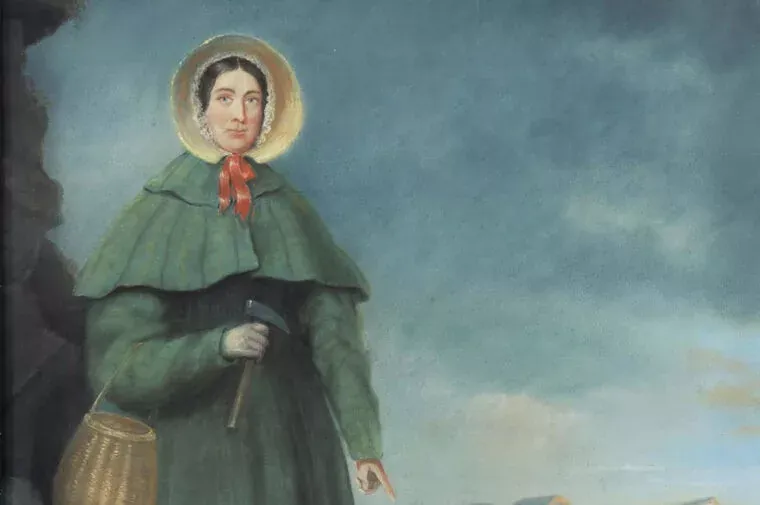
Facts About Mary Anning, the First Great Fossil Hunter
FFacts On Tap Editorial Team Fact-checkedUpdated January 21, 20264 min read
Share
Mary Anning never had a formal education, yet she became one of the most important fossil finders in the history of science. Working the crumbling cliffs of Lyme Regis, England, she uncovered marine reptiles no one had ever seen before, all while being shut out of the scientific societies that relied on her discoveries.
Here's what's actually true about her remarkable life and legacy.
Mary Anning was born on May 21, 1799, in Lyme Regis, on England's fossil-rich Jurassic Coast.
As an infant, Anning survived a lightning strike that killed three other women sheltering with her under a tree; she was reportedly a sickly baby before but grew notably healthier afterward, a story locals long saw as a sign of her future brilliance.
Her father, Richard Anning, was a cabinetmaker who supplemented his income by collecting and selling fossils, and he taught Mary and her brother Joseph how to find and clean them.
After Richard Anning died in 1810, the family continued the fossil-selling business to help make ends meet.
In 1811, Mary's brother Joseph uncovered the skull of a strange fossilized creature; a few months later, in 1812, twelve- or thirteen-year-old Mary excavated the rest of the skeleton herself.
That find was later identified as an ichthyosaur, a dolphin-like marine reptile, and it caused a sensation among naturalists who were still debating whether species could go extinct.
In 1823, Anning discovered the first complete skeleton of a plesiosaur, a long-necked marine reptile, a find so unusual that the eminent anatomist Georges Cuvier initially suspected it was a fake.
In 1828, Anning found the first pterosaur skeleton discovered outside Germany, identified as Dimorphodon macronyx, extending the known range of flying reptiles.
She also identified fossilized fish feces, later named coprolites by William Buckland, helping scientists understand the diets of ancient marine reptiles.
Anning ran a shop called Anning's Fossil Depot in Lyme Regis, where collectors and scientists from across Europe came to buy her specimens.
Despite her expertise, Anning was barred from joining the Geological Society of London because she was a woman; the society did not admit women as fellows until 1904.
Scientists frequently bought her fossils, wrote them up in papers, and received the credit and fame, while Anning herself went largely unrecognized in her lifetime.
Geologist Henry De la Beche created the 1830 print 'Duria Antiquior' (A More Ancient Dorset), based on Anning's discoveries, and sold copies to raise money for her.
In 1838, the British Association for the Advancement of Science, at the urging of geologist William Buckland, secured Anning an annual government annuity of £25 in recognition of her contributions to science.
Anning died of breast cancer on March 9, 1847, at age 47.
After her death, Geological Society president Henry De la Beche wrote and read a eulogy for her, an honor never before given to a non-member, let alone a woman.
Members of the Geological Society funded a stained-glass memorial window for Anning in the parish church of St. Michael's in Lyme Regis, unveiled in 1850.
The tongue-twister 'She sells seashells by the seashore' is widely believed to have been inspired by Mary Anning, though the rhyme was published decades after her death and the link is unproven.
Many of the fossils Anning found, including her ichthyosaur and plesiosaur specimens, are now held by London's Natural History Museum.
In 2010, the Royal Society named Anning one of the ten most influential women in the history of British science.
Frequently asked questions
Who was Mary Anning?
Mary Anning (1799-1847) was a self-taught English fossil hunter and collector from Lyme Regis whose discoveries of marine reptile skeletons, including ichthyosaurs and plesiosaurs, were foundational to early paleontology.
What was Mary Anning's most famous discovery?
Her most famous find is the first correctly identified ichthyosaur skeleton, uncovered with her brother Joseph in 1811-1812 when she was about 12 years old. She later found the first complete plesiosaur skeleton in 1823.
What obstacles did Mary Anning face as a woman in science?
As a working-class woman, Anning was barred from joining the Geological Society of London and other scientific institutions of her era. Male scientists often bought her fossils, published the findings, and received the credit she rarely got in her lifetime.
Did Mary Anning inspire the 'she sells seashells' tongue twister?
It's a popular claim, but there's no solid historical evidence linking her directly to the rhyme, which wasn't published until decades after her death.
What is Mary Anning's legacy today?
Anning is now recognized as one of the most important figures in the history of paleontology. Her fossils are displayed in major museums, the Geological Society named her among its most significant contributors, and she has been the subject of books, documentaries, and films.
We write every article to be genuinely fun — and genuinely true. Each fact is checked against reputable sources before it goes live. Spotted something off? Tell us and read our fact-check policy.