FFacts On Tap Editorial Team Fact-checkedUpdated February 16, 20264 min read
Share
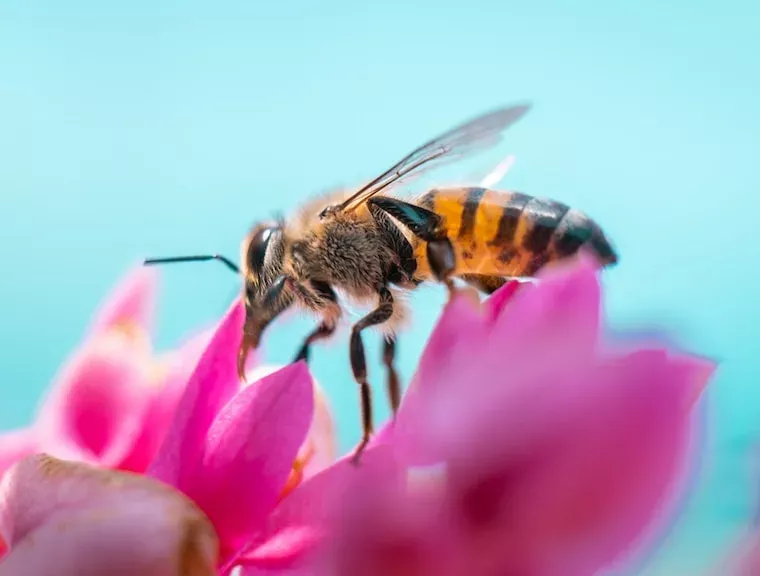
Bees are some of the hardest-working insects on the planet, quietly pollinating a huge share of the crops and wild plants we depend on. But beyond the pollen and honey, bees are strange and brilliant little creatures with senses and behaviors that sound almost like science fiction.
Here are fact-checked, fun bee facts that show just how remarkable these tiny fliers really are.
There are more than 20,000 known species of bees worldwide.
Bees can be trained to recognize and distinguish images of human faces in lab studies, likely using the same pattern-recognition tricks they use to tell flowers apart.
Bees have five eyes: two large compound eyes for detailed vision and three small simple eyes (ocelli) on top of the head that detect light and help with orientation.
Honeybees can fly at speeds of roughly 15 to 20 miles per hour.
A honeybee's wings beat about 200 times per second, which is what produces its characteristic buzz.
Bees communicate the location of food to their hivemates through a "waggle dance" that encodes both direction and distance.
A group of honeybees living together is called a colony.
A healthy queen honeybee can lay up to about 2,000 eggs a day during peak season.
Bees can technically fly in light rain, but wet wings make flying harder, so they usually shelter in the hive when a real storm rolls in.
Bees can see ultraviolet light, which helps them spot patterns on flowers that are invisible to the human eye.
Honeybees are the main insect that produces food eaten by humans on a commercial scale, though a few other insects, such as honeypot ants, also make edible sweet substances.
Bees pollinate roughly one-third of the food crops humans eat, from apples to almonds.
Bees are drawn to bright colors and sweet scents, which is how flowers advertise their nectar.
Bees can learn to recognize different flower species by their color, shape, and smell.
Bees use the position of the sun, along with polarized light patterns in the sky, to navigate to and from the hive.
Bumblebees can sense the weak electric fields given off by flowers, which may help them judge whether a flower has already been visited.
Bees are ancient insects: the oldest known bee fossil, preserved in amber, is roughly 100 million years old.
Bees have tiny branched hairs covering their bodies that trap pollen grains as they move from flower to flower.
A honeybee has two stomachs: one for digesting its own food and a separate "honey stomach" for carrying nectar back to the hive.
Bees also communicate through vibration and buzzing signals inside the dark hive, not just the waggle dance.
Honeybees typically forage within about 1 to 2 miles of their hive, though they can travel up to 5 miles or more when food is scarce nearby.
Bees see blue and purple especially well and are strongly attracted to flowers in those colors.
Frequently asked questions
How do bees make honey?
Worker bees collect nectar and carry it back to the hive in a special honey stomach. There, nectar is passed between bees and repeatedly regurgitated and enzymatically broken down, then fanned with wings to evaporate excess water until it thickens into honey.
How long do bees live?
It depends on the bee's role. Worker honeybees typically live only a few weeks in summer, while a queen bee can live several years.
Are all bees social insects?
No. While honeybees and bumblebees live in colonies, most of the world's bee species, including many mason bees and mining bees, are solitary and do not form hives.
Why are bees important for the environment?
Bees pollinate a huge share of flowering plants and food crops. Without them, many fruits, vegetables, and wild plants would struggle to reproduce, which would ripple through entire ecosystems and food supplies.
How can I help bees?
Plant a variety of bee-friendly, nectar-rich flowers, avoid pesticides in your garden, and consider buying honey from local beekeepers to support healthy hives in your area.
Can honeybees sting more than once?
Worker honeybees can only sting once. Their barbed stinger lodges in the victim's skin and tears away from the bee's body, which kills the bee shortly afterward. Queen bees and many other bee species have smoother stingers and can sting repeatedly.
We write every article to be genuinely fun — and genuinely true. Each fact is checked against reputable sources before it goes live. Spotted something off? Tell us and read our fact-check policy.