FFacts On Tap Editorial Team Fact-checkedUpdated April 23, 20263 min read
Share
Eagles have symbolized power and freedom for centuries, and it's easy to see why. These birds of prey combine razor-sharp vision, crushing talons, and remarkable flight skills that make them some of the most formidable hunters in the animal kingdom.
Here are 20 fact-checked facts about eagles, from their record-breaking dives to the surprising truth behind that famous "eagle screech" you've heard in movies.
Eagles are found on every continent except Antarctica.
There are more than 60 recognized species of eagles worldwide.
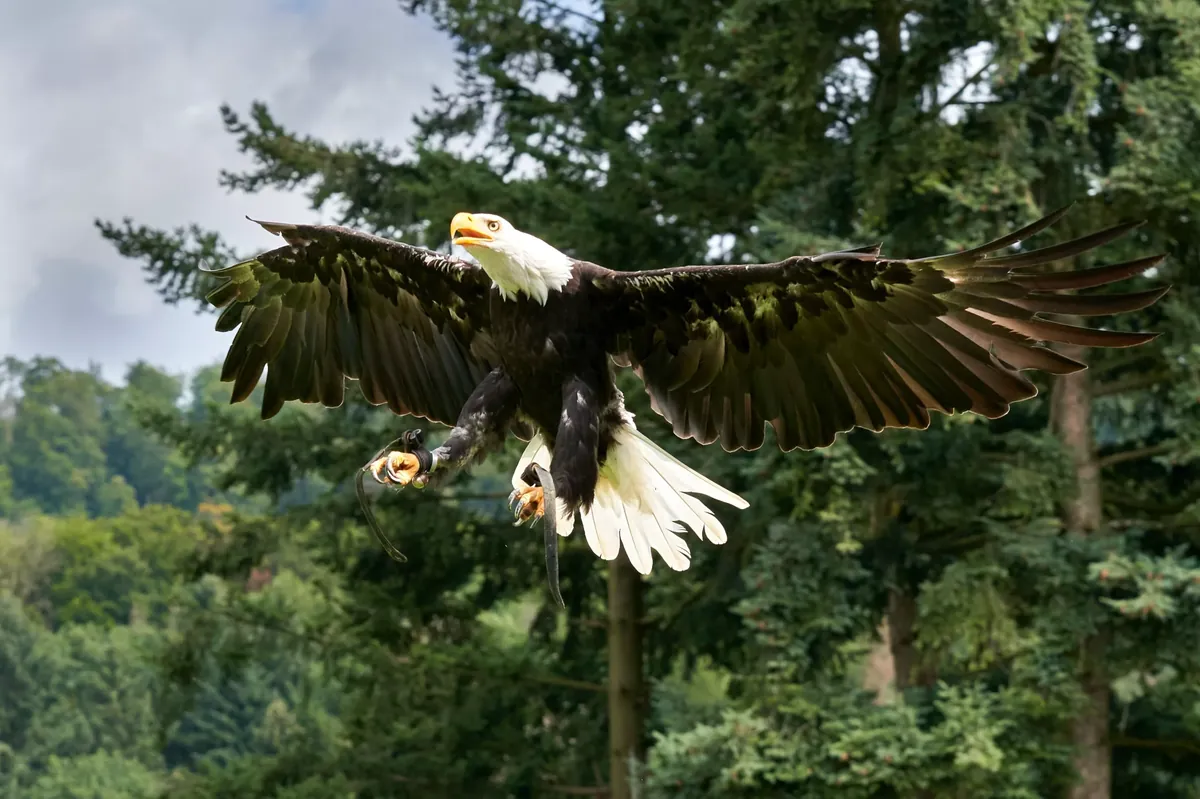
The bald eagle is the national bird and national symbol of the United States.
Eagles have extraordinarily sharp eyesight, estimated at several times sharper than a human's, letting large species spot prey from roughly two miles away.
Eagles have a strong, hooked beak used for tearing apart prey.
An eagle's wingspan can range from about 6 to 8 feet, depending on the species.
Eagles are generally monogamous and often keep the same mate for life.
Eagles build large nests, called eyries, on high cliffs or in tall trees; some nests are reused and added to for years, growing enormous over time.
Among the heaviest eagles are the harpy eagle and Steller's sea eagle, with large females of both species weighing up to about 20 pounds; the Philippine eagle is longer overall but somewhat lighter.
Eagles use their sharp, powerful talons, not their beak, to catch and kill prey.
Eagles are apex predators, sitting at the top of their food chain.
The golden eagle is the national bird of Mexico and appears on the Mexican flag, shown eating a snake while perched on a cactus.
Eagles typically live 20 to 30 years in the wild, and can live even longer in captivity.
In normal flight eagles cruise at around 30 to 40 mph, but a diving golden eagle can reach speeds of roughly 150 to 200 mph during a hunting stoop.
The dramatic eagle screech often heard in movies is usually not an eagle at all; it's a red-tailed hawk's cry dubbed in, since a bald eagle's real call is a comparatively weak, chirpy whistle.
Eagles have a nictitating membrane, a translucent third eyelid that protects and moistens their eyes during flight.
During courtship displays, eagles sometimes lock talons in midair and cartwheel together toward the ground before breaking apart.
A bald eagle's grip strength has been estimated at around 400 pounds per square inch, several times stronger than an average human hand grip.
Eagles have long served as symbols of power and strength, appearing on national emblems and flags around the world.
Many eagle species are protected by law. In the United States, the bald eagle recovered from near-extinction and was removed from the endangered species list in 2007, though it remains protected under the Bald and Golden Eagle Protection Act.
Frequently asked questions
What do eagles eat?
Eagles are carnivores that primarily eat fish, small mammals, birds, and carrion, depending on the species and habitat.
How fast can eagles fly?
Eagles cruise at around 30 to 40 mph in normal flight, but a golden eagle diving after prey can reach speeds of roughly 150 to 200 mph.
How long do eagles live?
Eagles typically live 20 to 30 years in the wild, and often longer in captivity where they aren't exposed to the same hazards.
What is the largest species of eagle?
It depends on how you measure it: the harpy eagle and Steller's sea eagle are the heaviest by weight, while the Philippine eagle is the longest and has the largest wing surface area.
How do eagles hunt?
Eagles rely mainly on keen eyesight to spot prey from a distance, then use powerful talons to catch and kill it, often diving at high speed.
What is the range of an eagle's wingspan?
An eagle's wingspan generally ranges from about 6 to 8 feet, depending on the species.
We write every article to be genuinely fun — and genuinely true. Each fact is checked against reputable sources before it goes live. Spotted something off? Tell us and read our fact-check policy.