FFacts On Tap Editorial Team Fact-checkedUpdated August 17, 20233 min read
Share
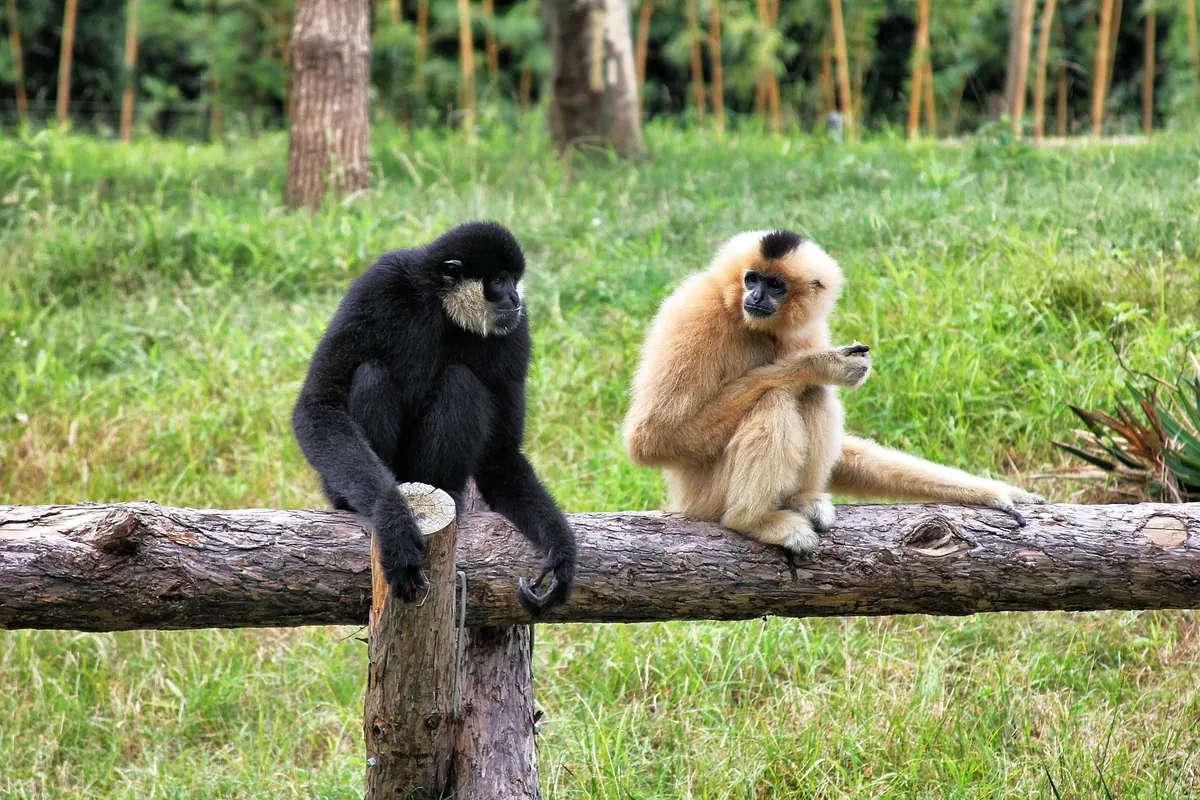
Gibbons are small apes in the family Hylobatidae, found swinging through the rainforest canopies of Southeast Asia. Often called "lesser apes" to distinguish them from great apes like chimpanzees and orangutans, gibbons are famous for their incredible arm-over-arm swinging, loud singing duets, and tight-knit family bonds.
Here are some verified facts about these remarkable primates.
Gibbons are small apes belonging to the family Hylobatidae, found in the tropical and subtropical rainforests of Southeast Asia.
Gibbons are highly vocal and use a variety of calls to communicate with each other and with neighboring groups.
They are renowned for their acrobatic "brachiation," swinging hand-over-hand from branch to branch at speeds that can exceed 30 mph (about 50 km/h).
Gibbons have arms that are much longer than their legs, giving them an exceptional reach for swinging through the trees.
Gibbons do not have tails at all, unlike most other primates.
Most gibbon species form long-term pair bonds, though researchers have found that they are not always strictly monogamous for life as once believed.
Gibbons are primarily frugivorous, meaning fruit makes up the bulk of their diet.
They also eat leaves, flowers, insects, and occasionally small animals or bird eggs, depending on the season and what's available.
Their signature style of movement, brachiation, involves swinging from branch to branch using only their arms.
Gibbons can also walk upright on two legs for short distances, often balancing with their arms raised overhead.
Gibbons are diurnal, meaning they are active during the day and sleep at night.
They spend nearly all of their lives high in the forest canopy and rarely descend to the ground.
There are roughly 20 recognized species of gibbons, grouped into four genera, each with distinct physical and vocal characteristics.
All gibbon species are considered threatened, with most classified as endangered or critically endangered due to habitat loss, poaching, and the illegal wildlife trade.
Gibbons are protected under the Convention on International Trade in Endangered Species of Wild Fauna and Flora (CITES).
Gibbons typically live around 25 years in the wild, and can live into their 30s or 40s in captivity.
Like other apes, gibbons have opposable thumbs, which help them grip branches and manipulate objects.
Many gibbon species perform elaborate vocal duets with their mates, often at dawn, which can be heard over a mile away.
These songs help establish and defend territory, strengthen the pair bond, and signal group location to family members.
The siamang, the largest gibbon species, can weigh up to about 30 pounds (roughly 14 kg), nearly twice the size of most other gibbons.
Gibbons have dense fur that ranges in color from black to cream and light brown, helping insulate them in the rainforest.
Siamangs have a distinctive inflatable throat sac that amplifies their loud calls across the forest.
Frequently asked questions
What is the difference between a gibbon and an ape?
Gibbons are apes themselves, often called "lesser apes" to distinguish them from the "great apes" (chimpanzees, gorillas, orangutans, and humans). Compared to great apes, gibbons are smaller, have proportionally longer arms, and are far more specialized for swinging through trees.
Do gibbons make good pets?
No. Gibbons require a specialized diet, a complex social and physical environment, and strong family bonds that cannot be replicated in a home, and keeping them as pets is illegal in most places and harmful to the animal.
What is the biggest threat to gibbons?
Habitat loss from deforestation and agricultural expansion is the leading threat, compounded by poaching and the illegal pet and wildlife trade.
How do gibbons protect themselves from predators?
Gibbons rely on speed and agility to flee through the canopy and use loud alarm calls to warn family members of nearby threats.
Can gibbons swim?
Gibbons are not strong swimmers and generally avoid water, preferring to stay in the trees; they will cross rivers by swinging across overhanging branches rather than swimming when possible.
Are gibbons intelligent?
Yes, gibbons show notable cognitive abilities, including problem-solving and tool use in some observed and experimental settings, though they are generally considered less tool-oriented than great apes like chimpanzees.
We write every article to be genuinely fun — and genuinely true. Each fact is checked against reputable sources before it goes live. Spotted something off? Tell us and read our fact-check policy.